
fuzzyclust.validity.fuzzy_adjusted_rand_index#
- fuzzyclust.validity.fuzzy_adjusted_rand_index(U1, U2, method='huellermeier', tnorm=None)[source]#
Fuzzy adjusted Rand index (chance-corrected), from the fuzzy pair counts of
fuzzy_rand_index().\[ARI=\frac{a-\frac{(a+b)(a+c)}{a+b+c+d}}{\frac12\bigl((a+b)+(a+c)\bigr)-\frac{(a+b)(a+c)}{a+b+c+d}}\](Hubert and Arabie’s correction applied to the fuzzy pair counts). Zero in expectation for independent partitions, one for identical ones; coincides with
sklearn.metrics.adjusted_rand_scorefor hard partitions.
Examples using fuzzyclust.validity.fuzzy_adjusted_rand_index#
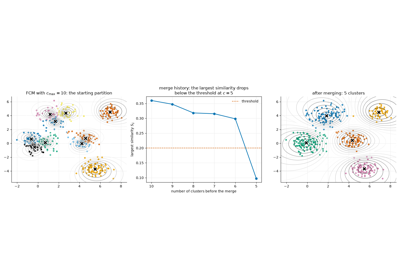
Three routes to the number of clusters: merging, validity scan, and stability
Three routes to the number of clusters: merging, validity scan, and stability
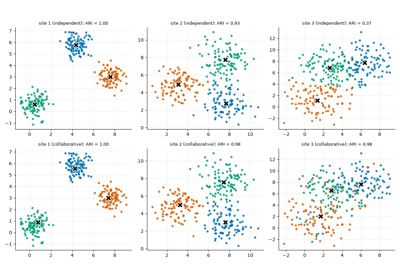
Collaborative fuzzy clustering across three data sites
Collaborative fuzzy clustering across three data sites
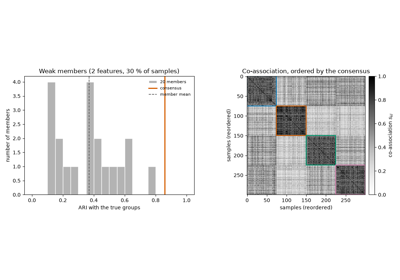
Consensus of soft clusterings: a library beats a single run
Consensus of soft clusterings: a library beats a single run