
fuzzyclust.cluster.SubtractiveClustering#
- class fuzzyclust.cluster.SubtractiveClustering(radii=0.5, squash=1.25, accept_ratio=0.5, reject_ratio=0.15, max_clusters=None)[source]#
Bases:
_DensityPeaksSubtractive clustering (Chiu, 1994): cluster centers from the potential of the data points.
Every data point is a candidate center. Its potential is the sum of Gaussian influences of all other points within a neighborhood radius \(r_a\); the point of highest potential becomes the first center, its influence (with a somewhat larger radius \(r_b\)) is subtracted from the potential of all points, and the next highest potential is examined. A candidate is accepted when its remaining potential is still a large fraction of the first one, rejected—and the procedure stopped—when it is a small fraction, and in between accepted only if it is far enough from the existing centers. The method is the data-point version of the mountain method (
MountainClustering), which it frees from the exponential cost of a grid, and it is the classical estimator of the number of rules of a Takagi–Sugeno model identified in the product space of inputs and output. The data are scaled to the unit hypercube internally, so the radii are fractions of the data range.- Parameters:
- radii
floator array_likeofshape(n_features,), default=0.5 Neighborhood radius \(r_a\) of a center as a fraction of the range of every feature (one value per feature allowed). Smaller radii give more clusters. Chiu recommends \(0.2\)–\(0.5\) for his examples; \(0.5\) is the usual default.
- squash
float, default=1.25 Squash factor \(\eta\): the potentials are revised with the radius \(r_b=\eta\,r_a>r_a\) so that no center is placed close to an existing one.
- accept_ratio
float, default=0.5 Acceptance ratio \(\bar\varepsilon\): a candidate with potential above \(\bar\varepsilon P^*_1\) is accepted outright.
- reject_ratio
float, default=0.15 Rejection ratio \(\underline\varepsilon\): a candidate with potential below \(\underline\varepsilon P^*_1\) is rejected and the search ends.
- max_clusters
intorNone, default=None Upper bound on the number of centers (
None: no bound).
- radii
- Attributes:
- cluster_centers_
ndarrayofshape(n_clusters_,n_features) The selected data points, in the original units.
- center_indices_
ndarrayofshape(n_clusters_,) Row indices of the centers in the training data.
- n_clusters_
int Number of centers found.
- potentials_
ndarrayofshape(n_clusters_,) Potential \(P^*_i\) of every center at the moment of its selection, relative to the first (\(P^*_1=1\)).
- initial_potentials_
ndarrayofshape(n_samples,) Potential of every training sample before any subtraction (a density estimate).
- membership_
ndarrayofshape(n_samples,n_clusters_) Normalized Gaussian memberships of the training samples (
predict_proba).- labels_
ndarrayofshape(n_samples,) Nearest center of every training sample.
- radii_
ndarrayofshape(n_features,) Radii actually used (in the unit hypercube).
- n_features_in_, feature_names_in_
- cluster_centers_
Notes
With the data scaled to \([0,1]^n\) and \(\alpha=4/r_a^2\), \(\beta=4/r_b^2\), the potential of sample \(k\) is
\[P_k=\sum_{l=1}^{N}\exp\bigl(-\alpha\,\|\mathbf{x}_k-\mathbf{x}_l\|^2\bigr),\](with a per-feature radius the squared distance is \(\sum_j(x_{kj}-x_{lj})^2/r_j^2\) and \(\alpha=4\)). After the selection of the center \(\mathbf{x}^*_i\) with potential \(P^*_i\), the potentials are revised,
\[P_k\leftarrow P_k-P^*_i\exp\bigl(-\beta\,\|\mathbf{x}_k-\mathbf{x}^*_i\|^2\bigr),\]and the candidate with the largest remaining potential is accepted if \(P^*>\bar\varepsilon P^*_1\), rejected (end) if \(P^*<\underline\varepsilon P^*_1\), and otherwise accepted only if \(d_{\min}/r_a+P^*/P^*_1\ge1\), where \(d_{\min}\) is its distance to the nearest existing center; a candidate that fails this test has its potential set to zero and the next one is examined. The returned centers can be passed as
inittoFCMorGKtogether withn_clusters_, andn_clusters_of a run on the product-space data[X, y]is a rule-number estimate forTakagiSugeno.References
[1]S. L. Chiu, “Fuzzy model identification based on cluster estimation”, Journal of Intelligent and Fuzzy Systems 2(3), 267–278, 1994.
[2]R. R. Yager, D. P. Filev, “Approximate clustering via the mountain method”, IEEE Transactions on Systems, Man, and Cybernetics 24(8), 1279–1284, 1994.
Examples
>>> from fuzzyclust.cluster import SubtractiveClustering, FCM
>>> from fuzzyclust.datasets import make_fuzzy_blobs
>>> X, _ = make_fuzzy_blobs(n_clusters=4, random_state=0)
>>> sub = SubtractiveClustering(radii=0.3).fit(X)
>>> int(sub.n_clusters_)
4
>>> fcm = FCM(n_clusters=sub.n_clusters_, init=sub.cluster_centers_).fit(X)
>>> fcm.n_iter_ < 20
True
- fit(X, y=None)[source]#
Estimate the cluster centers.
- Parameters:
- Xarray_like
ofshape(n_samples,n_features) - y
Ignored
- Xarray_like
- Returns:
- self
object
- self
Examples using fuzzyclust.cluster.SubtractiveClustering#
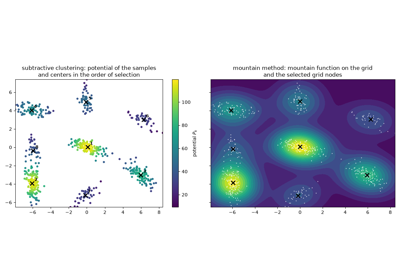
Subtractive clustering: the number and location of clusters from density