
fuzzyclust.timeseries.select_embedding_dimension#
- fuzzyclust.timeseries.select_embedding_dimension(table, ratio_tol=1.2)[source]#
Read the embedding and the local dimension off an
embedding_scan()table.The embedding dimension \(d_e\) is the smallest dimension after which a further coordinate reduces the one-step test error by less than the factor
ratio_tol(the paper compares the ratio of neighboring MSE values, e.g. 1.231 against 1.005). The local dimension \(d_l\) is one less than the dimension at which the prior-weighted smallest eigenvalue \(J^{d_e}\) drops most sharply (largest ratio \(J^{d-1}/J^{d}\)), because the clusters become flat once the embedding dimension exceeds the dimension of the manifold they approximate. The second criterion is reliable when the attractor lies close to a smooth low-dimensional manifold and only indicative for strongly fractal ones (thencorrelation_dimension()is the complement).- Parameters:
- table
pandas.DataFrame Output of
embedding_scan()(dimensions must be consecutive).- ratio_tol
float, default=1.2
- table
- Returns:
- result
sklearn.utils.Bunch embedding_dimension,local_dimensionand the two criteriamse_ratioandeigenvalue_ratioas Series.
- result
Examples using fuzzyclust.timeseries.select_embedding_dimension#
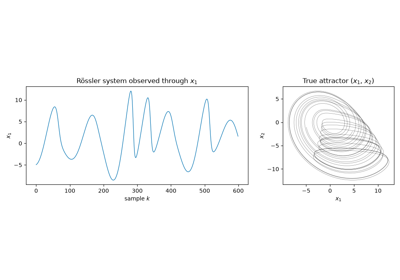
State-space reconstruction and prediction of a chaotic time series