
fuzzyclust.timeseries.make_nonlinear_io_system#
- fuzzyclust.timeseries.make_nonlinear_io_system(n_samples=2000, dt=0.2, u_range=(0.007, 0.015), substeps=10, discard=50, random_state=None)[source]#
Continuous polymerization reactor benchmark of the FNN model-order paper.
Free-radical polymerization of methyl methacrylate (Doyle, Ogunnaike & Pearson, 1995) as used by Feil, Abonyi & Szeifert:
\[\begin{split}\dot x_1 &= 10(6-x_1) - 2.4568\,x_1\sqrt{x_2},\\ \dot x_2 &= 80u - 10.1022\,x_2,\\ \dot x_3 &= 0.0024121\,x_1\sqrt{x_2} + 0.112191\,x_2 - 10x_3,\\ \dot x_4 &= 245.978\,x_1\sqrt{x_2} - 10x_4,\qquad y = x_4/x_3 .\end{split}\]The input \(u\) (dimensionless initiator flow) is a uniformly distributed random sequence in
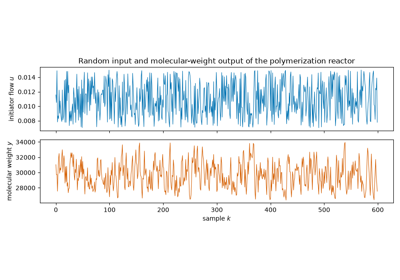
u_rangeheld constant over each sampling perioddt(zero-order hold); the output \(y\) is the number-average molecular weight, roughly in the range 26 000–34 000. (The FNN paper prints the first coefficient of \(\dot x_3\) as 0.024121; the value 0.0024121 of the original model is used here, which reproduces the stated output range.) A NARX model with one lagged output and two lagged inputs (\(n_a=1\), \(n_b=2\)) describes the system well, which is the reference answer of the model-order selection example.Examples
>>> from fuzzyclust.timeseries import make_nonlinear_io_system
>>> u, y = make_nonlinear_io_system(n_samples=200, random_state=0)
>>> u.shape, bool(20000 < y.mean() < 40000)
((200,), True)
Examples using fuzzyclust.timeseries.make_nonlinear_io_system#
Model-order selection by false nearest neighbors with a cluster-based threshold