
fuzzyclust.models.make_sinc#
- fuzzyclust.models.make_sinc(n_samples=200, noise=0.02, n_features=1, random_state=None)[source]#
Samples of the sinc function, the classic static benchmark of fuzzy modeling.
\[y = \frac{\sin x}{x}\quad (n=1),\qquad y = \frac{\sin x_1}{x_1}\,\frac{\sin x_2}{x_2}\quad (n=2),\]with \(x_j\) drawn uniformly from \([-10, 10]\) and additive Gaussian noise of standard deviation
noise.- Parameters:
- n_samples
int, default=200 - noise
float, default=0.02 - n_features{1, 2}, default=1
- random_state
int,RandomStateinstanceorNone, default=None
- n_samples
- Returns:
Examples
>>> from fuzzyclust.models import make_sinc
>>> X, y = make_sinc(n_samples=50, random_state=0)
>>> X.shape, y.shape
((50, 1), (50,))
Examples using fuzzyclust.models.make_sinc#
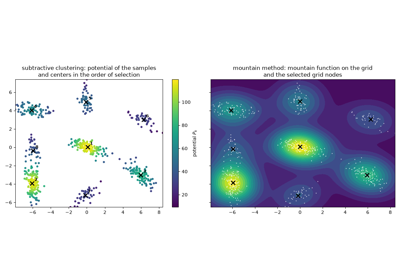
Subtractive clustering: the number and location of clusters from density
Subtractive clustering: the number and location of clusters from density
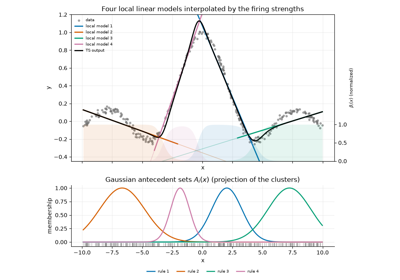
Takagi–Sugeno model of a static nonlinearity: clusters become rules
Takagi–Sugeno model of a static nonlinearity: clusters become rules