
fuzzyclust.incomplete.IncompleteFCM#
- class fuzzyclust.incomplete.IncompleteFCM(n_clusters=3, m=2.0, strategy='pds', tol=0.0001, max_iter=300, init='random', n_init=1, random_state=None, verbose=0)[source]#
Bases:
BaseFuzzyClustererFuzzy c-means clustering of incomplete data (Hathaway and Bezdek, 2001).
Missing feature values are marked by
NaN. Four strategies of running fuzzy c-means on such data are available (strategy):"wds"Whole-data strategy: samples with missing values are dropped and FCM is run on the complete samples only. The incomplete samples then receive memberships from their partial distances to the prototypes (the paper’s own suggestion for classifying them). Adequate when few samples are incomplete.
"pds"Partial-distance strategy: every sample takes part, the distance to a prototype is the partial distance
partial_distances()over the observed features (rescaled to the full dimension), and every prototype coordinate is the membership-weighted mean of the samples that observe it."ocs"Optimal-completion strategy: the missing values are additional variables of the c-means functional. Each is updated to the value that minimizes \(J\) for the current partition, the membership-weighted mean of the prototype coordinates; FCM then runs on the completed data. OCS imputes the data as a by-product.
"nps"Nearest-prototype strategy: like OCS, but a missing value is replaced by the coordinate of the nearest prototype of its sample (a hard version of OCS, cheaper and a little less accurate).
- Parameters:
- n_clusters
int, default=3 Number of clusters \(c\).
- m
float, default=2.0 Fuzziness exponent \(m>1\).
- strategy{“wds”, “pds”, “ocs”, “nps”}, default=”pds”
How the missing values are handled (see above).
- tol
float, default=1e-4 Termination tolerance on \(\max_{ik}|\Delta\mu_{ik}|\).
- max_iter
int, default=300 - init{“random”, “kmeans++”}
orndarray, default=”random” Initialization, see
BaseFuzzyClusterer. It is computed on the data with the missing values provisionally filled by the feature means of the observed values.- n_init
int, default=1 Random restarts; the run with the lowest final \(J\) is kept.
- random_state
int,RandomStateinstanceorNone, default=None - verbose
int, default=0
- n_clusters
- Attributes:
- cluster_centers_
ndarrayofshape(n_clusters,n_features) Prototypes \(\mathbf{v}_i\).
- membership_
ndarrayofshape(n_samples,n_clusters) Fuzzy partition \(\mathbf{U}^T\) of all samples (for
"wds"the incomplete samples are classified by their partial distances after the fit).- labels_
ndarrayofshape(n_samples,) - distances_
ndarrayofshape(n_samples,n_clusters) Distances at convergence: Euclidean on the completed data for
"ocs"/"nps", partial distances otherwise.- missing_mask_
ndarrayofboolofshape(n_samples,n_features) Truewhere a value was missing.- n_missing_
int Number of missing values.
- X_completed_
ndarrayofshape(n_samples,n_features) The data with the missing values filled in. For
"ocs"and"nps"these are the values the algorithm optimized; for"pds"and"wds"they are a post-hoc estimate by the OCS formula (membership-weighted prototype coordinates) from the final partition, not used by the algorithm.- covariances_
ndarrayofshape(n_clusters,n_features,n_features) Fuzzy covariances of the final partition on the completed data.
- objective_, objective_history_, n_iter_
See
BaseFuzzyClusterer.
- cluster_centers_
Notes
Let \(I_{kj}=1\) when \(x_{kj}\) is observed (
0when it is missing), \(I_k=\sum_j I_{kj}\), \(X_M\) the set of missing values and \(X_P\) the observed ones. The strategies optimize the c-means functional \(J=\sum_i\sum_k\mu_{ik}^m D^2_{ik}\) as follows.PDS – the partial distance and the prototype update
\[D^2_{ik}=\frac{n}{I_k}\sum_{j=1}^{n}I_{kj}(x_{kj}-v_{ij})^2,\qquad v_{ij}=\frac{\sum_{k=1}^{N}\mu_{ik}^m I_{kj}\,x_{kj}}{\sum_{k=1}^{N}\mu_{ik}^m I_{kj}},\]with the usual membership formula.
OCS – \(J\) is minimized over \((\mathbf{U},\mathbf{V},X_M)\); the necessary condition for a missing value is
\[x_{kj}=\frac{\sum_{i=1}^{c}\mu_{ik}^m v_{ij}}{\sum_{i=1}^{c}\mu_{ik}^m}, \qquad x_{kj}\in X_M ,\]and the memberships and prototypes are those of FCM on the completed data. The three-block alternating optimization decreases \(J\) monotonically.
NPS – the missing value is set to the coordinate of the prototype nearest to the sample, \(x_{kj}=v_{ij}\) with \(i=\arg\min_l D^2_{lk}\), the nearest prototype being judged by the partial distance over the observed features.
WDS – plain FCM on the complete samples; the incomplete ones are classified afterwards with partial distances.
Hathaway and Bezdek ran the strategies on IRIS with 0–75 % of the values missing completely at random and compared the prototypes with those of FCM on the complete data: PDS and OCS were the most accurate, NPS close behind, and WDS degraded once a large share of the samples was affected; OCS has the extra merit of imputing the data. OCS and NPS change the data they cluster and therefore have more local optima than PDS – use
n_initor start them from the PDS prototypes (init=pds.cluster_centers_) when the result matters.References
[1]R. J. Hathaway, J. C. Bezdek, “Fuzzy c-means clustering of incomplete data”, IEEE Transactions on Systems, Man, and Cybernetics, Part B 31(5), 735–744, 2001.
[2]J. K. Dixon, “Pattern recognition with partly missing data”, IEEE Transactions on Systems, Man, and Cybernetics 9(10), 617–621, 1979.
Examples
>>> import numpy as np
>>> from fuzzyclust.datasets import make_fuzzy_blobs
>>> from fuzzyclust.incomplete import IncompleteFCM, make_mcar
>>> X, _ = make_fuzzy_blobs(random_state=0)
>>> Xm = make_mcar(X, missing_rate=0.2, random_state=0)
>>> model = IncompleteFCM(n_clusters=3, strategy="ocs", random_state=0).fit(Xm)
>>> model.membership_.shape, bool(np.isnan(model.X_completed_).any())
((300, 3), False)
- fit(X, y=None)[source]#
Cluster incomplete data (
NaNmarks a missing value).- Parameters:
- Xarray_like
ofshape(n_samples,n_features) Data with
NaNfor missing values. Every sample must observe at least one feature and every feature must be observed at least once.- y
Ignored
- Xarray_like
- Returns:
- self
object
- self
- predict_proba(X)[source]#
Memberships of (possibly incomplete) new samples from their partial distances.
- Returns:
- U
ndarrayofshape(n_samples,n_clusters)
- U
Examples using fuzzyclust.incomplete.IncompleteFCM#
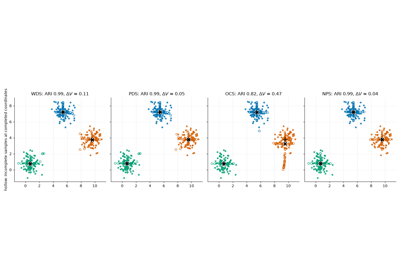
Clustering incomplete data: the four strategies of Hathaway and Bezdek
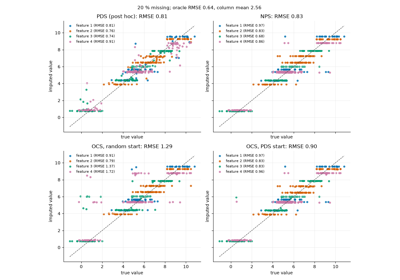
Imputation by clustering: accuracy of the completed values