
fuzzyclust.timeseries.MixedInputStructureSelection#
- class fuzzyclust.timeseries.MixedInputStructureSelection(n_clusters=3, max_inputs=None, m=2.0, vct_tolerance=0.2, random_state=None)[source]#
Bases:
BaseEstimatorEstimator form of
select_structure_mixed().- Parameters:
- Attributes:
- ranking_
pandas.DataFrame All evaluated structures sorted by \(\sigma_t\) (see
select_structure_mixed()).- memberships_
listofndarrays Fuzzy (or crisp) partition of every input, shape
(n_samples, c_j).- centers_
listofndarrays Cluster centers (continuous inputs) or the distinct values (discrete inputs).
- best_structure_
tupleofstr Recommended structure: among the structures whose \(\sigma_t\) lies within
vct_toleranceof the smallest one (structures of “similar variance”, the only ones the paper compares by VCT), the one with the smallest \(VCT\). This is the first dip of the VCT curve in the paper’s figures.- feature_names_
listofstr - discrete_
ndarrayofbool - n_features_in_
int
- ranking_
See also
select_structure_mixedfunctional interface with the full description.
- fit(X, y, discrete=None, feature_names=None)[source]#
Partition every input and rank all structures of at most
max_inputsinputs.- Parameters:
- Xarray_like
ofshape(n_samples,n_inputs) - yarray_like
ofshape(n_samples,) - discretearray_like
ofbool orint,optional Mask or indices of the discrete inputs.
- feature_namessequence
ofstr,optional Defaults to the DataFrame columns or
x1, x2, ....
- Xarray_like
Examples using fuzzyclust.timeseries.MixedInputStructureSelection#
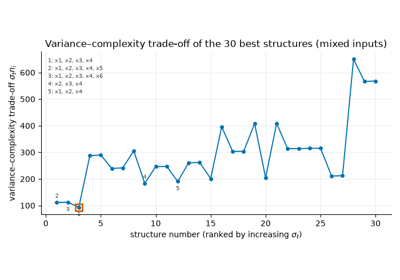
Model-free structure selection with mixed discrete and continuous inputs