
fuzzyclust.extensions.make_crossing_lines#
- fuzzyclust.extensions.make_crossing_lines(n_lines=3, n_samples_per_line=80, length=8.0, noise=0.1, angles=None, center=(0.0, 0.0), random_state=None)[source]#
Line segments that cross at a common point.
Crossing lines are the classical test case of the fuzzy c-lines algorithm: near the crossing the points of all lines are close to each other, so point and ellipsoid prototypes (FCM, GK) cut the lines into pieces around the crossing, whereas a line prototype measures only the orthogonal distance and assigns each point to the line it lies on.
- Parameters:
- n_lines
int, default=3 Number of lines (ignored when
anglesis given).- n_samples_per_line
int, default=80 - length
float, default=8.0 Length of every segment, centered on the crossing.
- noise
float, default=0.1 Standard deviation of the orthogonal scatter around the lines.
- anglessequence
offloat,optional Orientation of the lines in degrees; default equally spaced in \([0^\circ, 180^\circ)\).
- center(
x,y), default=(0, 0) The crossing point.
- random_state
int,RandomStateinstanceorNone
- n_lines
- Returns:
Examples using fuzzyclust.extensions.make_crossing_lines#
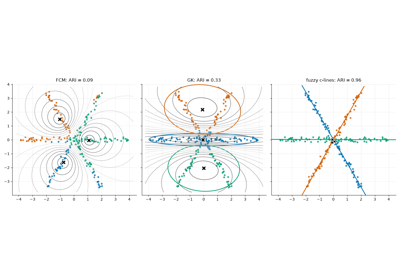
Fuzzy c-varieties: lines as prototypes, and the elliptotype compromise
Fuzzy c-varieties: lines as prototypes, and the elliptotype compromise