
fuzzyclust.timeseries.make_mackey_glass#
- fuzzyclust.timeseries.make_mackey_glass(n_samples=2000, tau=17, a=0.2, b=0.1, n=10, dt=1.0, x0=1.2, discard=1000, substeps=10)[source]#
Mackey–Glass delay-differential series (chaotic for \(\tau=17\)).
\[\frac{dx}{dt} = \frac{a\,x(t-\tau)}{1+x(t-\tau)^{n}} - b\,x(t)\]integrated with a fourth-order Runge–Kutta scheme on a grid of
dt / substepswith linear interpolation of the delayed value, and sampled everydt. The firstdiscardsamples (transient) are dropped.tau=17gives the classical benchmark with a fractal dimension of about 2.1,tau=30a higher-dimensional attractor.- Returns:
- x
ndarrayofshape(n_samples,)
- x
Examples
>>> from fuzzyclust.timeseries import make_mackey_glass
>>> x = make_mackey_glass(n_samples=500)
>>> x.shape, bool(0.2 < x.min() < x.max() < 1.6)
((500,), True)
Examples using fuzzyclust.timeseries.make_mackey_glass#
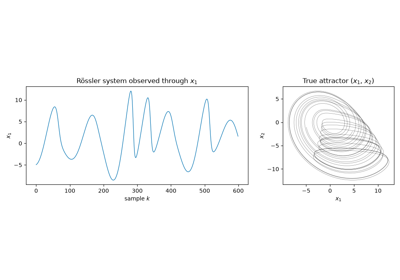
State-space reconstruction and prediction of a chaotic time series
State-space reconstruction and prediction of a chaotic time series