
fuzzyclust.large.make_drifting_stream#
- fuzzyclust.large.make_drifting_stream(n_chunks=20, chunk_size=2000, n_clusters=3, n_features=2, drift=0.15, spread=0.6, box=8.0, random_state=None)[source]#
A stream of chunks whose cluster centers drift from chunk to chunk.
Every chunk \(l\) holds
chunk_sizesamples ofn_clustersisotropic Gaussian clusters whose centers move by a constant drift vector per chunk (each cluster its own random direction, step lengthdrift). A generator is returned, so that chunks can be consumed one by one withpartial_fit().- Parameters:
- Yields:
Examples
>>> from fuzzyclust.large import make_drifting_stream
>>> chunks = list(make_drifting_stream(n_chunks=3, chunk_size=100, random_state=0))
>>> len(chunks), chunks[0][0].shape, chunks[-1][2].shape
(3, (100, 2), (3, 2))
Examples using fuzzyclust.large.make_drifting_stream#
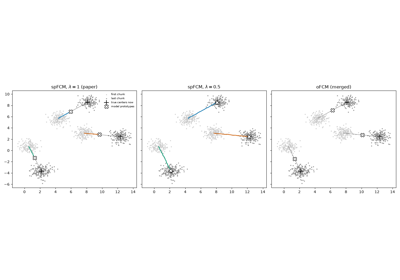
Clustering a drifting stream chunk by chunk with partial_fit
Clustering a drifting stream chunk by chunk with partial_fit