
fuzzyclust.timeseries.bottom_up_segmentation#
- fuzzyclust.timeseries.bottom_up_segmentation(X, n_components=2, max_error=None, n_segments=None, cost='q', init_length=10, center=True)[source]#
Bottom-up segmentation with PCA models (Keogh et al. style, multivariate extension).
The series is first cut into pieces of
init_lengthsamples. The cost of merging every pair of adjacent segments – the PCA cost (pca_segment_cost()) of the union – is computed and the cheapest pair is merged, until the cheapest merge would cost more thanmax_erroror untiln_segmentssegments are left. The cost is the level of the model error of the merged segment (not its increase), somax_erroris the natural stopping rule;n_segmentsis offered for comparisons with a known number of segments. This is the multivariate counterpart of the piecewise-linear-approximation bottom-up algorithm (Appendix A of Abonyi et al., 2005) used there as the baseline: with the \(Q\) cost it detects changes of the correlation structure, with the \(T^2\) cost shifts of the operating point.- Parameters:
- Xarray_like
ofshape(n_samples,n_features) - n_components
int, default=2 Number of principal components \(p\) of the segment models.
- max_error
float,optional Stop when the cheapest merge costs more than this (ignored if
n_segmentsis given).- n_segments
int,optional Stop when this many segments are left.
- cost{“q”, “t2”}, default=”q”
- init_length
int, default=10 Length of the initial fine segments.
- centerbool, default=True
Use the covariance of each segment (centered data).
Falseuses the uncentred second-moment matrix as printed in eqs. (30)-(31) of the paper; the cost is then dominated by the level of the variables and the greedy merging becomes unreliable unless the data are centered beforehand.
- Xarray_like
- Returns:
- result
sklearn.utils.Bunch labels(segment index per sample),boundaries(start indices of the segments except the first),segments(list of(start, stop)pairs),merge_costs(cost of every merge made, in order) andn_segments.
- result
References
[1]E. Keogh, S. Chu, D. Hart, M. Pazzani, “An online algorithm for segmenting time series”, Proc. IEEE ICDM, 2001.
[2]J. Abonyi, B. Feil, S. Németh, P. Árva, “Modified Gath–Geva clustering for fuzzy segmentation of multivariate time-series”, Fuzzy Sets and Systems 149 (2005) 39–56, Appendix A.
Examples
>>> from fuzzyclust.timeseries import bottom_up_segmentation, make_piecewise_timeseries
>>> X, _ = make_piecewise_timeseries(n_samples=400, change_points=(200,),
...                                  change_kinds=("correlation",), random_state=0)
>>> res = bottom_up_segmentation(X, n_components=2, n_segments=2)
>>> res.n_segments, abs(int(res.boundaries[0]) - 200) <= 10
(2, True)
Examples using fuzzyclust.timeseries.bottom_up_segmentation#
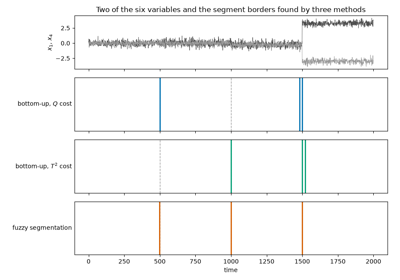
Bottom-up segmentation with PCA models versus fuzzy segmentation