
fuzzyclust: fuzzy clustering and data analysis in Python#
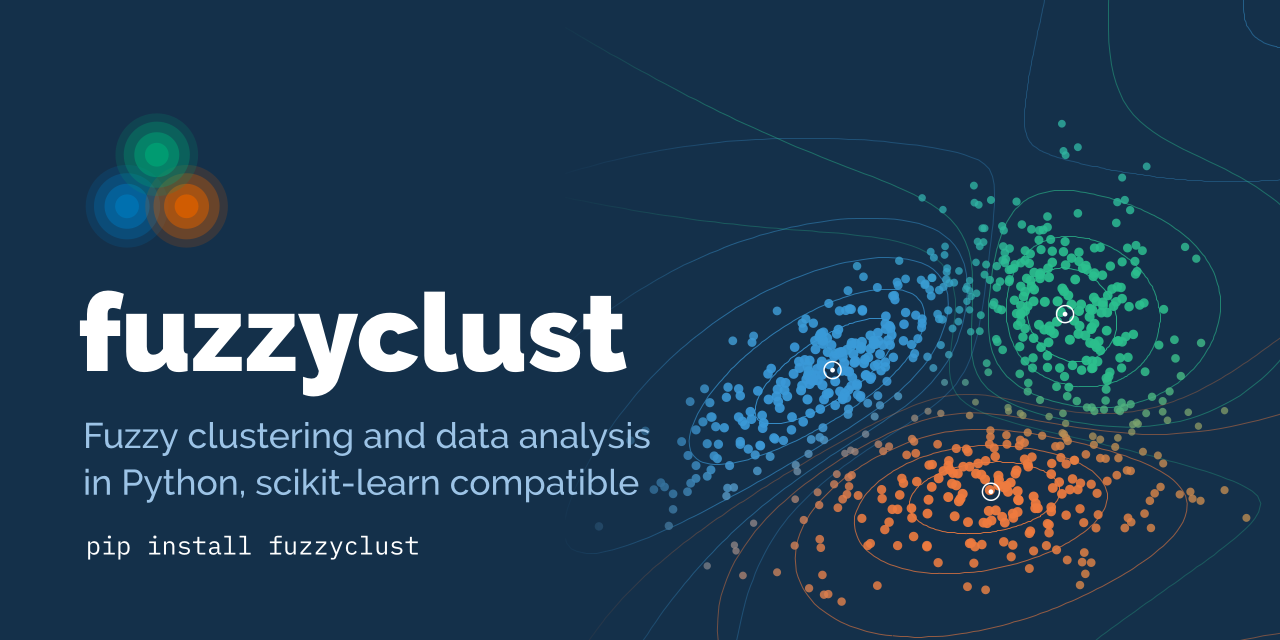
fuzzyclust is a scikit-learn compatible toolbox for fuzzy clustering and the data-analysis methods built on it. It succeeds the Fuzzy Clustering and Data Analysis Toolbox for MATLAB (Balaskó, Abonyi and Feil) and collects the clustering-based methods developed in the Abonyi group over two decades: model identification, time-series segmentation, visualization of fuzzy clusters and graph-based clustering, together with the possibilistic, noise, kernel and shape-prototype variants of fuzzy c-means and methods for relational, incomplete, very large and image data.
K-means, k-medoids, fuzzy c-means, Gustafson–Kessel and Gath–Geva on one alternating-optimization template; generalized fuzzifiers, subtractive clustering, cluster merging.
Sixteen validity indices, scans over the number of clusters, fuzzy Rand indices and stability-based selection.
Possibilistic and noise clustering, kernel FCM, c-varieties, c-shells, volume prototypes and feature weighting.
Minimal-spanning-tree hybrids and geodesic-distance fuzzy c-medoids.
PCA, Sammon and fuzzy Sammon mapping, projection quality, fuzzy SOM.
Takagi–Sugeno identification, fuzzy classifiers, regression trees, segmentation, model order, chaotic prediction.
Relational FCM, NERF c-means, fuzzy c-medoids, fuzzy k-modes and k-prototypes; DTW, autocorrelation and Gower dissimilarities.
FCM with missing values; weighted, sampling, single-pass and online FCM; spatial FCM variants for image segmentation.
Partial supervision, pairwise constraints, co-clustering, collaborative clustering and cluster ensembles.
Quick start#
pip install fuzzyclust
from fuzzyclust.cluster import GK
from fuzzyclust.datasets import make_fuzzy_blobs
from fuzzyclust.plotting import plot_clusters, plot_membership_contours

X, _ = make_fuzzy_blobs(n_clusters=3, random_state=0)
gk = GK(n_clusters=3, m=2.0, random_state=0).fit(X)

gk.membership_        # fuzzy partition matrix, shape (n_samples, n_clusters)
gk.cluster_centers_   # prototypes
gk.covariances_       # fuzzy covariance matrices of the GK clusters
gk.predict_proba(X)   # memberships of (new) samples

ax = plot_clusters(X, gk.labels_, gk.cluster_centers_)
plot_membership_contours(gk, X, ax=ax)
Every estimator is a scikit-learn estimator: it accepts NumPy arrays or
pandas DataFrames, works inside a Pipeline, and
exposes its results as fitted attributes.
Where to go next#
Installation: requirements and optional extras.
Example gallery: the example gallery: one runnable script per algorithm, each generating its own data, explaining the method and the effect of its parameters. Every example can be downloaded as a Jupyter notebook.
The book: the book Fuzzy Clustering and Data Analysis in Python: theory with a unified notation, algorithm boxes and the same examples.
API reference: the API reference.
Migrating from the MATLAB toolbox: coming from the MATLAB toolbox.