
fuzzyclust.timeseries.delay_embedding#
- fuzzyclust.timeseries.delay_embedding(y, dim, delay=1)[source]#
Delay vectors \(\mathbf{y}_k=[y_k, y_{k-\tau},\dots,y_{k-\tau(d_e-1)}]^T\) of a scalar series.
- Parameters:
- yarray_like
ofshape(T,) - dim
int Embedding dimension \(d_e\).
- delay
int, default=1 Lag \(\tau\) (in samples), usually the first zero of the autocorrelation or the first minimum of the mutual information.
- yarray_like
- Returns:
- Y
ndarrayofshape(T-delay* (dim- 1),dim) Row
iis the delay vector at timek = i + delay * (dim - 1).
- Y
Examples
>>> from fuzzyclust.timeseries import delay_embedding
>>> delay_embedding([0., 1., 2., 3., 4.], dim=3, delay=1)
array([[2., 1., 0.],
       [3., 2., 1.],
       [4., 3., 2.]])
Examples using fuzzyclust.timeseries.delay_embedding#
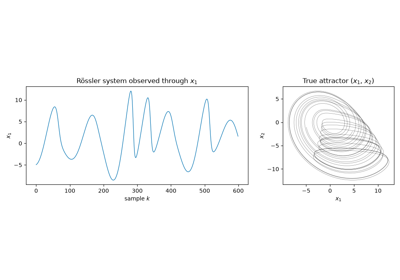
State-space reconstruction and prediction of a chaotic time series
State-space reconstruction and prediction of a chaotic time series