
fuzzyclust.viz.Sammon#
- class fuzzyclust.viz.Sammon(n_components=2, max_iter=100, alpha=0.3, init='pca', tol=1e-06, backtracking=True, max_backtracks=10, random_state=None)[source]#
Bases:
TransformerMixin,BaseEstimatorSammon’s nonlinear mapping to a low-dimensional space.
Sammon mapping is a multidimensional-scaling method: it looks for \(N\) points \(\mathbf{y}_k\in\mathbb{R}^q\) whose pairwise Euclidean distances \(d^*_{kl}\) reproduce the pairwise distances \(d_{kl}=\|\mathbf{x}_k-\mathbf{x}_l\|\) of the original \(n\)-dimensional data as closely as possible. In contrast to PCA, which preserves variance, the mapping preserves distances, which is the quantity clustering algorithms work with.
- Parameters:
- n_components
int, default=2 Dimension \(q\) of the embedding.
- max_iter
int, default=100 Maximum number of iterations of the pseudo-Newton descent.
- alpha
float, default=0.3 Step size (“magic factor”) of the update, Sammon recommends 0.3-0.4. Larger values converge faster but may oscillate.
- init{“pca”, “random”}
orndarrayofshape(n_samples,n_components), default=”pca” Initial configuration.
"pca"starts from the principal component scores (deterministic and usually close to the optimum),"random"from uniform noise in \([-0.5, 0.5]^q\) (MATLAB toolbox behavior).- tol
float, default=1e-6 Stop when the relative decrease of the stress between two iterations falls below
tol.- backtrackingbool, default=True
Safeguard the update: displacements longer than 30 times the median displacement are clipped, and the step is halved (at most
max_backtrackstimes) whenever it would increase the stress. Sammon’s diagonal Newton step divides by the curvature, which can be arbitrarily small for single points and then throws them far away; the safeguard makes the stress history (almost always) monotone at the cost of one extra distance evaluation per halving. WithFalsethe raw update of the original algorithm is used.- max_backtracks
int, default=10 - random_state
int,RandomStateinstanceorNone, default=None Seed for
init="random".
- n_components
- Attributes:
Notes
The stress
\[E = \frac{1}{\lambda}\sum_{k<l}\frac{(d_{kl}-d^*_{kl})^2}{d_{kl}},\qquad \lambda=\sum_{k<l}d_{kl},\]is minimized in the \(Nq\) coordinates \(y_{kl}\) by the diagonal Newton step proposed by Sammon,
\[y_{kl}(t+1) = y_{kl}(t) - \alpha\, \frac{\partial E/\partial y_{kl}}{\left|\partial^2 E/\partial y_{kl}^2\right|},\]with
\[\begin{split}\frac{\partial E}{\partial y_{kl}} &= -\frac{2}{\lambda}\sum_{j\neq k} \frac{d_{kj}-d^*_{kj}}{d_{kj}d^*_{kj}}\,(y_{kl}-y_{jl}),\\ \frac{\partial^2 E}{\partial y_{kl}^2} &= -\frac{2}{\lambda}\sum_{j\neq k} \frac{1}{d_{kj}d^*_{kj}}\left[(d_{kj}-d^*_{kj}) - \frac{(y_{kl}-y_{jl})^2}{d^*_{kj}}\left(1+\frac{d_{kj}-d^*_{kj}}{d^*_{kj}}\right)\right].\end{split}\]All points are updated simultaneously and the configuration is re-centered after every step; by default the step is halved when it would increase the stress (
backtracking). Every iteration needs the \(N(N-1)/2\) pairwise distances of the current configuration, which makes the method expensive for large \(N\); this motivates the fuzzy Sammon mapping (FuzzySammon). The stress surface has local minima, so different initializations may give different maps.Projecting new samples is not defined for Sammon mapping (the whole optimization would have to be repeated), hence
transformraisesNotImplementedError; usefit_transform().References
[1]J. W. Sammon Jr., “A nonlinear mapping for data structure analysis”, IEEE Transactions on Computers C-18(5), 401-409, 1969.
[2]J. Mao, A. K. Jain, “Artificial neural networks for feature extraction and multivariate data projection”, IEEE Transactions on Neural Networks 6(2), 296-317, 1995.
Examples
>>> from fuzzyclust.datasets import make_fuzzy_blobs
>>> from fuzzyclust.viz import Sammon
>>> X, _ = make_fuzzy_blobs(n_clusters=3, n_features=5, random_state=0)
>>> sam = Sammon(n_components=2, max_iter=50, random_state=0)
>>> Y = sam.fit_transform(X)
>>> Y.shape, sam.stress_ < 0.1
((300, 2), True)
- fit(X, y=None)[source]#
Compute the embedding of
X.- Parameters:
- Xarray_like
ofshape(n_samples,n_features) - y
Ignored
- Xarray_like
- Returns:
- self
object
- self
Examples using fuzzyclust.viz.Sammon#
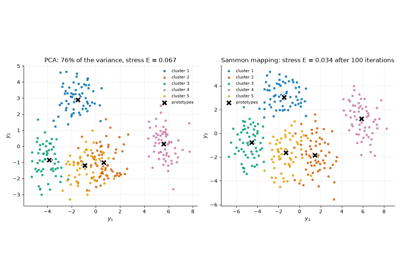
PCA versus Sammon mapping: preserving variance or distances
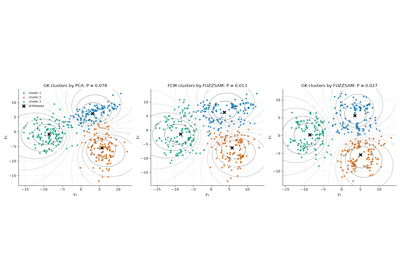
Fuzzy Sammon mapping: projecting clusters, not just data