
fuzzyclust.models.make_mimo_plant#
- fuzzyclust.models.make_mimo_plant(n_samples=600, hold=10, noise=0.0, random_state=None)[source]#
A two-input two-output nonlinear process with operating-point-dependent gains.
\[\begin{split}\begin{aligned} y_1(k+1) &= 0.8\,y_1(k) - 0.1\,y_2(k) + g_1(y_1(k))\,u_1(k) + 0.1\,u_2(k),\\ y_2(k+1) &= 0.1\,y_1(k) + 0.7\,y_2(k) + 0.2\,u_1(k) + g_2(y_2(k))\,u_2(k), \end{aligned}\end{split}\]with the gains \(g_1(y) = 0.2 + 0.4/(1+y^2)\) and \(g_2(y) = 0.1 + 0.5\,\exp(-y^2)\): the process is linear in the lagged variables but its input gains shrink as the outputs move away from zero, exactly the kind of behavior that a Takagi–Sugeno model with scheduling on the outputs interpolates between local linear models. The inputs are random step sequences in \([-1, 1]\), held for
holdsamples.Examples
>>> from fuzzyclust.models import make_mimo_plant
>>> u, y = make_mimo_plant(n_samples=100, random_state=0)
>>> u.shape, y.shape
((100, 2), (100, 2))
Examples using fuzzyclust.models.make_mimo_plant#
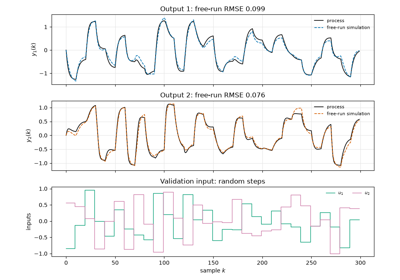
MIMO Takagi–Sugeno model with local MIMO ARX consequents
MIMO Takagi–Sugeno model with local MIMO ARX consequents