
fuzzyclust.extensions.make_collinear_segments#
- fuzzyclust.extensions.make_collinear_segments(n_samples_per_segment=60, length=3.0, gap=3.0, noise=0.1, extra_line=True, random_state=None)[source]#
Two collinear segments separated by a gap, optionally with a third, oblique segment.
A line prototype has no extent, so pure fuzzy c-lines cannot tell two collinear segments apart: both lie on the same line. The fuzzy c-elliptotypes compromise, which adds a share of the point distance, separates them by their position. The optional third segment makes the problem a genuine three-cluster one.
- Parameters:
- n_samples_per_segment
int, default=60 - length
float, default=3.0 Length of each collinear segment (on the x-axis).
- gap
float, default=3.0 Gap between the two collinear segments.
- noise
float, default=0.1 Orthogonal scatter around the segments.
- extra_linebool, default=True
Add an oblique segment above the gap (label 2).
- random_state
int,RandomStateinstanceorNone
- n_samples_per_segment
- Returns:
Examples using fuzzyclust.extensions.make_collinear_segments#
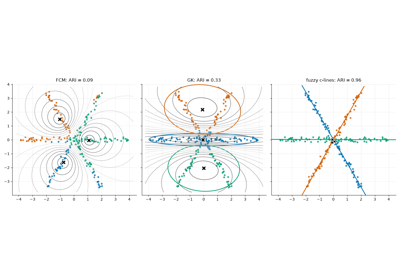
Fuzzy c-varieties: lines as prototypes, and the elliptotype compromise
Fuzzy c-varieties: lines as prototypes, and the elliptotype compromise