
fuzzyclust.preprocessing.normalize#
- fuzzyclust.preprocessing.normalize(X, method='var')[source]#
Scale the data and return the scaler for inverse transformation.
- Parameters:
- Xarray_like
ofshape(n_samples,n_features) - method{“var”, “range”}, default=”var”
"var": zero mean and unit variance per feature (\(\tilde{x}_{kj} = (x_{kj}-\bar{x}_j)/\sigma_j\));"range": linear scaling of every feature to \([0, 1]\).
- Xarray_like
- Returns:
Examples
>>> import numpy as np
>>> from fuzzyclust.preprocessing import normalize
>>> X = np.array([[1.0, 10.0], [2.0, 20.0], [3.0, 30.0]])
>>> Xs, scaler = normalize(X, "range")
>>> Xs.min(axis=0), Xs.max(axis=0)
(array([0., 0.]), array([1., 1.]))
Examples using fuzzyclust.preprocessing.normalize#
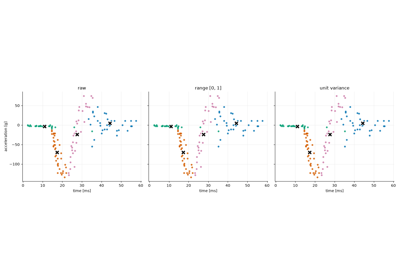
Feature scaling on real data: the motorcycle data set
Feature scaling on real data: the motorcycle data set