
fuzzyclust.extensions.PFCM#
- class fuzzyclust.extensions.PFCM(n_clusters=3, m=2.0, eta=2.0, a=1.0, b=1.0, gamma=None, gamma_scale=1.0, tol=0.0001, max_iter=300, init='fcm', n_init=1, random_state=None, verbose=0)[source]#
Bases:
BaseFuzzyClustererPossibilistic fuzzy c-means clustering (Pal, Pal, Keller and Bezdek).
PFCM combines the two views of cluster membership. Every sample gets a probabilistic membership \(\mu_{ik}\) as in FCM (rows sum to one; a relative quantity that says which cluster the sample belongs to more) and a typicality \(t_{ik}\) as in PCM (an absolute quantity that says how representative the sample is of the cluster). The memberships keep the prototypes apart and so avoid the coincident clusters of PCM, the typicalities make the prototypes insensitive to outliers. The weights \(a\) and \(b\) set the relative influence of the two in the prototype update.
- Parameters:
- n_clusters
int, default=3 Number of clusters \(c\).
- m
float, default=2.0 Exponent of the probabilistic memberships, \(m>1\).
- eta
float, default=2.0 Exponent \(\eta>1\) of the typicalities (the paper’s \(\eta\); it plays the role of \(m\) in PCM).
- a
float, default=1.0 Weight of the memberships in the objective (\(a\ge0\)).
- b
float, default=1.0 Weight of the typicalities (\(b\ge0\), not both zero). With
b > athe prototypes follow the typicalities and become more robust to outliers; the paper recommends \(b>a\) for noisy data and warns that a very large \(b\) brings back the coincident clusters of PCM.- gamma
None,floator array_likeofshape(n_clusters,), default=None Possibilistic scales \(\gamma_i\).
Noneestimates them from the initial FCM partition, see Notes.- gamma_scale
float, default=1.0 Multiplier \(K\) of the estimated scales.
- tol
float, default=1e-4 - max_iter
int, default=300 - init{“fcm”, “random”, “kmeans++”}
orndarray, default=”fcm” As in
PCM: an FCM run (or an explicit membership matrix) provides the initial partition and the scales.- n_init
int, default=1 Number of restarts; the run with the lowest objective is kept.
- random_state
int,RandomStateinstanceorNone, default=None - verbose
int, default=0
- n_clusters
- Attributes:
- cluster_centers_
ndarrayofshape(n_clusters,n_features) - membership_
ndarrayofshape(n_samples,n_clusters) Probabilistic memberships \(\mu_{ik}\) (rows sum to one).
- typicality_
ndarrayofshape(n_samples,n_clusters) Typicalities \(t_{ik}\) (rows do not sum to one).
- labels_
ndarrayofshape(n_samples,) membership_.argmax(axis=1).- gamma_
ndarrayofshape(n_clusters,) Scales \(\gamma_i\) used.
- distances_, objective_, objective_history_, n_iter_
See
BaseFuzzyClusterer.
- cluster_centers_
Notes
PFCM minimizes
\[J = \sum_{i=1}^{c}\sum_{k=1}^{N}\left(a\,\mu_{ik}^m + b\,t_{ik}^{\eta}\right)D^2_{ik} + \sum_{i=1}^{c}\gamma_i\sum_{k=1}^{N}(1-t_{ik})^{\eta}\]subject to \(\sum_i\mu_{ik}=1\) (no constraint on the typicalities), which gives the FCM membership formula for \(\mu_{ik}\), the PCM typicality formula with the scale \(\gamma_i/b\), and a prototype update weighted by both:
\[t_{ik} = \frac{1}{1+\left(b\,D^2_{ik}/\gamma_i\right)^{1/(\eta-1)}},\qquad \mathbf{v}_i = \frac{\sum_k\left(a\mu_{ik}^m+b\,t_{ik}^{\eta}\right)\mathbf{x}_k} {\sum_k\left(a\mu_{ik}^m+b\,t_{ik}^{\eta}\right)} .\]The scales are set from the FCM partition as in PCM, \(\gamma_i = K\sum_k\mu_{ik}^m D^2_{ik}/\sum_k\mu_{ik}^m\). With \(b=0\) PFCM reduces to FCM, with \(a=0\) to PCM.
predict_proba()returns the probabilistic memberships,predict_typicality()the typicalities of new samples.References
[1]N. R. Pal, K. Pal, J. M. Keller, J. C. Bezdek, “A possibilistic fuzzy c-means clustering algorithm”, IEEE Trans. Fuzzy Systems 13(4), 517–530, 2005.
Examples
>>> from fuzzyclust.extensions import PFCM
>>> from fuzzyclust.datasets import make_noisy_blobs
>>> X, _ = make_noisy_blobs(random_state=0)
>>> pfcm = PFCM(n_clusters=3, a=1.0, b=2.0, random_state=0).fit(X)
>>> pfcm.typicality_.shape
(330, 3)
>>> bool(abs(pfcm.membership_.sum(axis=1) - 1).max() < 1e-9)
True
Examples using fuzzyclust.extensions.PFCM#
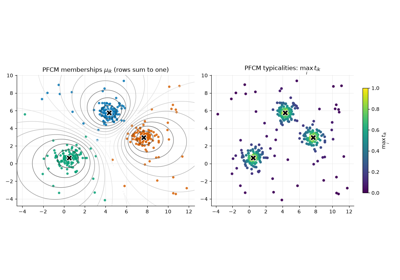
Possibilistic fuzzy c-means: memberships and typicalities together