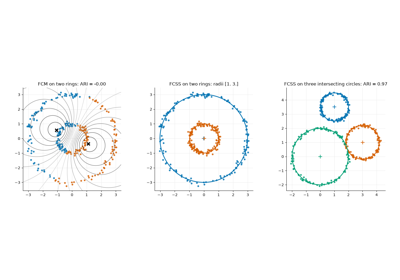
fuzzyclust.extensions.make_circles#
- fuzzyclust.extensions.make_circles(centers=((0.0, 0.0), (3.0, 1.0), (1.0, 3.5)), radii=(2.0, 1.2, 1.0), n_samples_per_circle=120, arc=1.0, noise=0.06, n_outliers=0, random_state=None)[source]#
Intersecting circles (shell clusters) with optional arcs and outliers.
Unlike
fuzzyclust.datasets.make_rings()the circles are not concentric, so they intersect and partly cover each other – the situation the fuzzy c-(spherical) shells algorithms were designed for.- Parameters:
- centerssequence
of(x,y) Centers of the circles.
- radiisequence
offloat Radii, one per center.
- n_samples_per_circle
int, default=120 - arc
float, default=1.0 Fraction of the full circle that is sampled (
1.0= closed circle,0.5= half circle starting at a random angle).- noise
float, default=0.06 Radial standard deviation of the points around the circle.
- n_outliers
int, default=0 Uniformly distributed outliers (label
-1).- random_state
int,RandomStateinstanceorNone
- centerssequence
- Returns: