
fuzzyclust.validity.stability_selection#
- fuzzyclust.validity.stability_selection(estimator, X, n_clusters_range=range(2, 11), n_splits=20, method='subsample', subsample=0.8, index='fuzzy_ari', random_state=None)[source]#
Stability of the partition against resampling, for every number of clusters.
A number of clusters that reflects structure in the data gives the same partition on different subsets of the data; a wrong one splits or merges groups arbitrarily and the partitions of two subsets disagree. Two protocols are implemented.
"subsample"(Ben-Hur, Elisseeff & Guyon, 2002): two random sub-samples of a fractionsubsampleof the data are clustered independently and their partitions compared on the samples they share."split"(Lange, Roth, Braun & Buhmann, 2004): the data are split into two halves, the estimator is fitted on each, the model of the first half predicts the memberships of the second half (predict_probaacts as the classifier of the original method), and the prediction is compared with the second half’s own partition.
The comparison uses a fuzzy partition index, by default the fuzzy adjusted Rand index, which is zero for chance agreement and so needs no further normalization (the raw fuzzy Rand index grows with \(c\) because pairs apart in both partitions count as agreement). The statistic to inspect is the distribution over splits: a stable \(c\) has a mean near one and a small spread.
- Parameters:
- estimator
fuzzyclustclusterer Cloned and refitted for every value of
n_clustersand every split.- Xarray_like
ofshape(n_samples,n_features) - n_clusters_rangeiterable
ofint, default=range(2, 11) - n_splits
int, default=20 Number of resampling repetitions per
n_clusters.- method{“subsample”, “split”}, default=”subsample”
- subsample
float, default=0.8 Fraction of the samples in every sub-sample (
"subsample"only).- index{“fuzzy_ari”, “fuzzy_rand”, “fuzzy_jaccard”}, default=”fuzzy_ari”
- random_state
int,RandomStateinstanceorNone
- estimator
- Returns:
pandas.DataFrameIndexed by
n_clusterswith one column per split (split_0, …);table.mean(axis=1).idxmax()is the most stable \(c\).
References
[1]A. Ben-Hur, A. Elisseeff, I. Guyon, “A stability based method for discovering structure in clustered data”, Pacific Symposium on Biocomputing 7, 6–17, 2002.
[2]T. Lange, V. Roth, M. L. Braun, J. M. Buhmann, “Stability-based validation of clustering solutions”, Neural Computation 16(6), 1299–1323, 2004.
Examples
>>> from fuzzyclust.cluster import FCM
>>> from fuzzyclust.datasets import make_fuzzy_blobs
>>> from fuzzyclust.validity import stability_selection
>>> X, _ = make_fuzzy_blobs(n_clusters=4, random_state=0)
>>> table = stability_selection(FCM(random_state=0), X, range(2, 7), n_splits=5, random_state=0)
>>> int(table.mean(axis=1).idxmax())
4
Examples using fuzzyclust.validity.stability_selection#
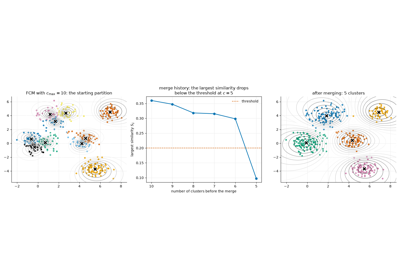
Three routes to the number of clusters: merging, validity scan, and stability