
fuzzyclust.large.make_large_blobs#
- fuzzyclust.large.make_large_blobs(n_samples=100000, n_clusters=5, n_features=2, weights=None, spread=0.6666666666666666, box=10.0, shuffle=True, random_state=None)[source]#
Many samples from a few isotropic Gaussian clusters, in random order.
The centers are drawn as in
fuzzyclust.datasets.make_fuzzy_blobs()(uniform in the box, at least \(4\sigma\) apart); the cluster sizes followweights(equal by default). The samples are shuffled so that consecutive chunks of the array are random samples of the whole, which is what the single-pass and online algorithms assume.- Parameters:
- n_samples
int, default=100000 - n_clusters
int, default=5 - n_features
int, default=2 - weightsarray_like
ofshape(n_clusters,),optional Relative sizes of the clusters (normalized internally).
- spread
float, default=1/1.5 Standard deviation of the clusters.
- box
float, default=10.0 - shufflebool, default=True
- random_state
int,RandomStateinstanceorNone
- n_samples
- Returns:
Examples
>>> from fuzzyclust.large import make_large_blobs
>>> X, y = make_large_blobs(n_samples=1000, n_clusters=4, random_state=0)
>>> X.shape, int(y.max()) + 1
((1000, 2), 4)
Examples using fuzzyclust.large.make_large_blobs#
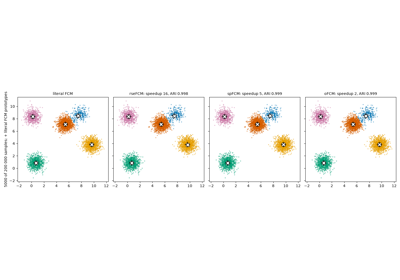
Fuzzy c-means for very large data: rseFCM, spFCM and oFCM
Fuzzy c-means for very large data: rseFCM, spFCM and oFCM