
fuzzyclust.cluster.PolynomialFuzzifierFCM#
- class fuzzyclust.cluster.PolynomialFuzzifierFCM(n_clusters=3, beta=0.5, tol=0.0001, max_iter=300, init='random', n_init=1, random_state=None, verbose=0)[source]#
Bases:
BaseFuzzyClustererFuzzy c-means with the polynomial fuzzifier of Klawonn and Höppner.
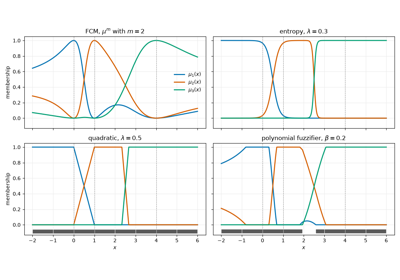
The fuzzifier \(\mu^m\) of FCM has a derivative of zero at \(\mu=0\), which forces every sample to have a positive membership in every cluster—even a cluster on the other side of the data set. Klawonn and Höppner replace \(\mu^m\) by the quadratic polynomial
\[g(\mu)=\frac{1-\beta}{1+\beta}\,\mu^2+\frac{2\beta}{1+\beta}\,\mu,\qquad 0\le\beta<1,\]whose slope at zero is \(2\beta/(1+\beta)>0\). A cluster whose distance exceeds that of the nearest prototype by a factor set by \(\beta\) then receives an exact zero membership, while the memberships between nearby prototypes stay fuzzy.
beta=0is FCM with \(m=2\); as \(\beta\to1\) the partition becomes crisp (k-means).- Parameters:
- n_clusters
int, default=3 Number of clusters \(c\).
- beta
float, default=0.5 Fuzzifier parameter \(\beta\in[0,1)\). A sample at distance \(D_1\) from its nearest prototype has zero membership in every cluster farther than \(D_1/\sqrt{\beta}\); \(\beta=0.5\) is the value recommended by the authors.
- tol
float, default=1e-4 - max_iter
int, default=300 - init{“random”, “kmeans++”}
orndarray, default=”random” - n_init
int, default=1 - random_state
int,RandomStateinstanceorNone, default=None - verbose
int, default=0
- n_clusters
- Attributes:
- cluster_centers_
ndarrayofshape(n_clusters,n_features) - membership_
ndarrayofshape(n_samples,n_clusters) Fuzzy partition with exact zeros.
- n_active_
ndarrayofshape(n_samples,) Number of clusters with positive membership per training sample.
- covariances_
ndarrayofshape(n_clusters,n_features,n_features) Fuzzy covariance matrices of the final partition (weights \(g(\mu_{ik})\)).
- labels_, distances_, objective_, objective_history_, n_iter_
See
BaseFuzzyClusterer.
- cluster_centers_
Notes
The functional \(J=\sum_i\sum_k g(\mu_{ik})D^2_{ik}\) is minimized under \(\sum_i\mu_{ik}=1\), \(\mu_{ik}\ge0\). With the \(\hat c_k\) nearest prototypes forming the active set \(A_k\) the memberships are
\[\mu_{ik}=\frac{1}{1-\beta}\left(\frac{1+(\hat c_k-1)\beta} {\sum_{j\in A_k}D^2_{ik}/D^2_{jk}}-\beta\right)\ (i\in A_k),\qquad \mu_{ik}=0\ (i\notin A_k),\]where \(\hat c_k\) is the largest size for which all these values are positive; the prototypes are the \(g(\mu_{ik})\)-weighted means. The weighting exponent is fixed at
m=1internally so that the base class passes the memberships themselves to the prototype update, where \(g\) is applied.References
[1]F. Klawonn, F. Höppner, “What is fuzzy about fuzzy clustering? Understanding and improving the concept of the fuzzifier”, Advances in Intelligent Data Analysis V (IDA 2003), LNCS 2810, 254–264, Springer, 2003.
Examples
>>> from fuzzyclust.cluster import PolynomialFuzzifierFCM
>>> from fuzzyclust.datasets import make_fuzzy_blobs
>>> X, _ = make_fuzzy_blobs(random_state=0)
>>> pf = PolynomialFuzzifierFCM(n_clusters=3, beta=0.5, random_state=0).fit(X)
>>> bool((pf.membership_ == 0).mean() > 0.3)
True
>>> float(pf.membership_.sum(axis=1).round(6).min())
1.0
Examples using fuzzyclust.cluster.PolynomialFuzzifierFCM#
What makes a partition fuzzy: fuzzifiers, regularization, and annealing