
Note
Go to the end to download the full example code or to run this example in your browser via Binder.
Collaborative fuzzy clustering across three data sites#
Three sites, such as hospitals, branches of a company or laboratories, describe the same 300 objects with different features, and the raw data may not leave the sites. Pedrycz’s collaborative clustering runs fuzzy c-means at every site, then lets the sites exchange only their partition matrices and re-cluster with a term that penalizes the difference from the other sites’ memberships,
The three sites below see the same three groups with increasingly blurred features (standard deviations 0.6, 1.2 and 1.8), and at the third site 15 % of the objects are moved to another group, so that this site genuinely disagrees with the others about those objects.
import matplotlib.pyplot as plt
import numpy as np
from sklearn.metrics import adjusted_rand_score

from fuzzyclust.collaborative import (
    CollaborativeFCM,
    make_collaborative_sites,
    plot_collaboration_trajectory,
    plot_site_partitions,
)
from fuzzyclust.plotting import PALETTE
from fuzzyclust.validity import fuzzy_adjusted_rand_index

Xs, y = make_collaborative_sites(n_sites=3, spreads=(0.6, 1.2, 1.8), swap_fraction=0.15, random_state=0)
Independent and collaborative partitions#
With \(\alpha=0\) the sites cluster independently (the clusters are matched across the sites by the Hungarian algorithm on their membership overlap). The clear site 1 finds the groups exactly, the blurred site 3 mixes them. With \(\alpha=3\) every site listens to the other two. Site 3 is pulled toward the structure the others agree on and even reassigns the objects whose features were moved (its clusters now overlap in its own feature space), while site 1 keeps its partition and only becomes softer.
# [snippet:fit]
independent = CollaborativeFCM(n_clusters=3, alpha=0.0, random_state=0).fit(Xs)
collab = CollaborativeFCM(n_clusters=3, alpha=3.0, random_state=0).fit(Xs)
for name, model in (("independent", independent), ("alpha = 3", collab)):
    print(f"{name:12s}: ARI per site = "
          + ", ".join(f"{adjusted_rand_score(y, lab):.2f}" for lab in model.labels_)
          + f";  membership change = {np.round(model.collaboration_change_, 3)}")
# [/snippet:fit]

fig, axes = plt.subplots(2, 3, figsize=(12, 7.4))
plot_site_partitions(Xs, independent, axes=axes[0], independent=True)
plot_site_partitions(Xs, collab, axes=axes[1])
for row, model in zip(axes, (independent, collab), strict=True):
    for p, ax in enumerate(row):
        ax.set_title(ax.get_title() + f": ARI = {adjusted_rand_score(y, model.labels_[p]):.2f}", fontsize=9)
plt.tight_layout()
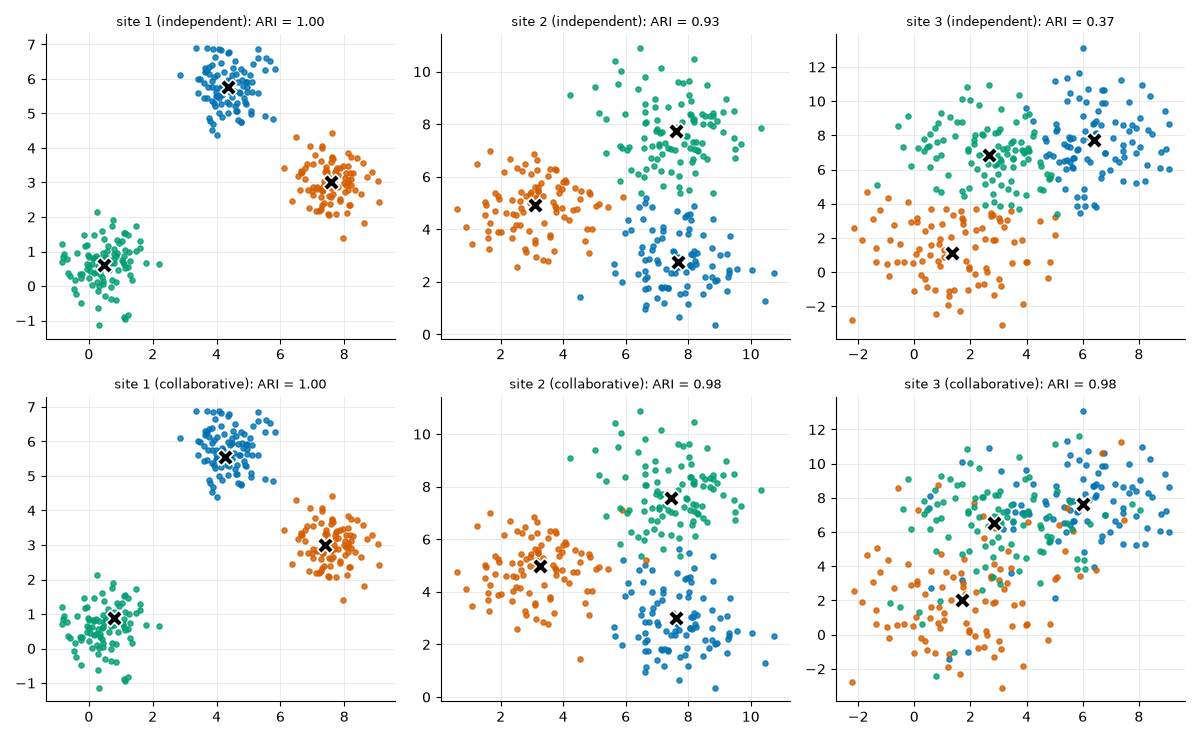
independent : ARI per site = 1.00, 0.93, 0.37;  membership change = [0. 0. 0.]
alpha = 3   : ARI per site = 1.00, 0.98, 0.98;  membership change = [0.099 0.073 0.127]
Parameter study: the collaboration weight \(\alpha\)#
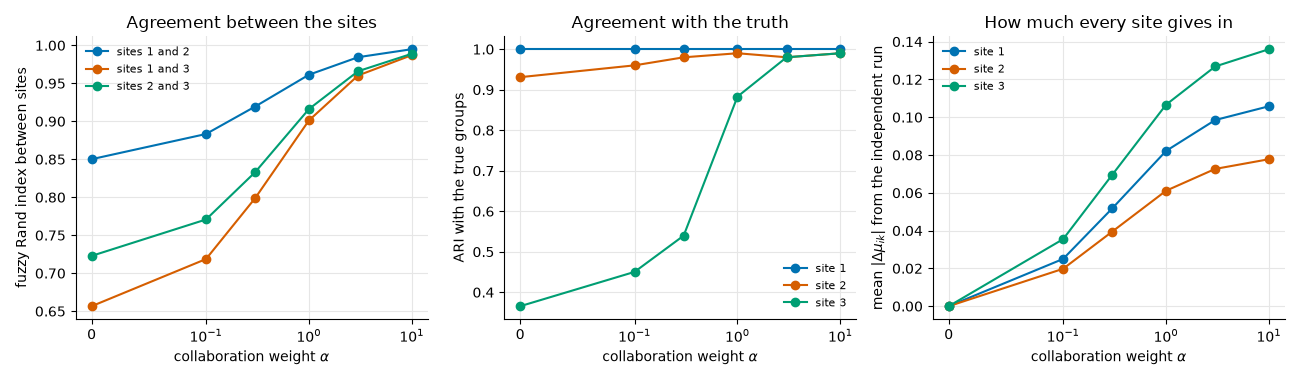
For a range of weights, we record the agreement between the sites (fuzzy
Rand index of their partitions, fuzzyclust.validity.fuzzy_rand_index())
and the agreement of every site with the true groups. The sites converge
to each other monotonically; the partition of the clear site stays
correct, the blurred sites improve, and site 3 follows the
majority on its moved objects from \(\alpha\approx1\) on. How far a
site has to move (collaboration_change_, the mean absolute change of
its memberships) measures how much it disagreed: site 3 gives in most,
but every site moves, because a membership pulled toward the others is
also a softer one.
# [snippet:scan]
alphas = (0.0, 0.1, 0.3, 1.0, 3.0, 10.0)
models = [CollaborativeFCM(n_clusters=3, alpha=a, random_state=0).fit(Xs) for a in alphas]
# [/snippet:scan]

fig, axes = plt.subplots(1, 3, figsize=(13, 3.8))
plot_collaboration_trajectory(alphas, models, ax=axes[0])
axes[0].set_xscale("symlog", linthresh=0.1)
axes[0].set_title("Agreement between the sites")
for p in range(3):
    axes[1].plot(alphas, [adjusted_rand_score(y, m.labels_[p]) for m in models], "o-", color=PALETTE[p],
                 label=f"site {p + 1}")
    axes[2].plot(alphas, [m.collaboration_change_[p] for m in models], "o-", color=PALETTE[p],
                 label=f"site {p + 1}")
axes[1].set_ylabel("ARI with the true groups")
axes[1].set_title("Agreement with the truth")
axes[2].set_ylabel(r"mean $|\Delta\mu_{ik}|$ from the independent run")
axes[2].set_title("How much every site gives in")
for ax in axes[1:]:
    ax.set_xscale("symlog", linthresh=0.1)
    ax.set_xlabel(r"collaboration weight $\alpha$")
    ax.grid(True, color="0.9")
    ax.legend(frameon=False, fontsize=8)
for s in ("top", "right"):
    for ax in axes[1:]:
        ax.spines[s].set_visible(False)
plt.tight_layout()
Asymmetric collaboration#
The collaboration matrix need not be symmetric. When only site 3 listens (row 3 of \(\alpha\) nonzero), sites 1 and 2 keep their independent partitions and site 3 alone is corrected; when only site 1 listens, the clear site is pulled toward the noisier ones and loses some of its clarity. The chance-corrected fuzzy adjusted Rand index between the consensus of the sites (their mean membership) and the truth is highest when only the deviating site listens: collaboration in all directions makes every partition softer, which the fuzzy index penalizes although the hard labels of all sites are then correct.
# [snippet:asymmetric]
listen_3 = np.array([[0, 0, 0], [0, 0, 0], [3.0, 3.0, 0]])
listen_1 = np.array([[0, 3.0, 3.0], [0, 0, 0], [0, 0, 0]])
for name, A in (("only site 3 listens", listen_3), ("only site 1 listens", listen_1),
                ("all listen", 3.0)):
    m = CollaborativeFCM(n_clusters=3, alpha=A, random_state=0).fit(Xs)
    truth = np.eye(3)[y]
    print(f"{name:20s}: ARI per site = "
          + ", ".join(f"{adjusted_rand_score(y, lab):.2f}" for lab in m.labels_)
          + f";  fuzzy ARI of the consensus = {fuzzy_adjusted_rand_index(truth, m.consensus_membership_):.2f}")
# [/snippet:asymmetric]
only site 3 listens : ARI per site = 1.00, 0.93, 1.00;  fuzzy ARI of the consensus = 0.72
only site 1 listens : ARI per site = 0.91, 0.93, 0.37;  fuzzy ARI of the consensus = 0.41
all listen          : ARI per site = 1.00, 0.98, 0.98;  fuzzy ARI of the consensus = 0.54
Take-away. Collaborative clustering reconciles the structures found at several sites without moving any raw data: only partition matrices travel. The collaboration weight sets how strongly a site defers to the others; increasing it pulls the partitions together monotonically and lets a weak or deviating site borrow the structure the others agree on, while a clear site barely moves. The amount by which every site has to change is itself informative, because it locates the site whose view of the objects differs. The collaboration matrix can be asymmetric, so trust can be given selectively.
Total running time of the script: (0 minutes 0.731 seconds)
