
fuzzyclust.datasets.make_fuzzy_blobs#
- fuzzyclust.datasets.make_fuzzy_blobs(n_clusters=3, n_samples_per_cluster=100, n_features=2, spread=0.6666666666666666, box=10.0, random_state=None)[source]#
Isotropic Gaussian clusters with random centers (MATLAB
nDexample).Centers are drawn uniformly in \([0, \text{box}]^n\) (rejecting draws closer than \(4\sigma\) to an existing center, so that clusters are well separated); every cluster has \(N_i\) samples \(\mathbf{x}_k\sim\mathcal{N}(\mathbf{v}_i,\sigma^2\mathbf{I})\) with \(\sigma=\)
spread. The ideal data set for FCM.- Parameters:
- Returns:
Examples using fuzzyclust.datasets.make_fuzzy_blobs#
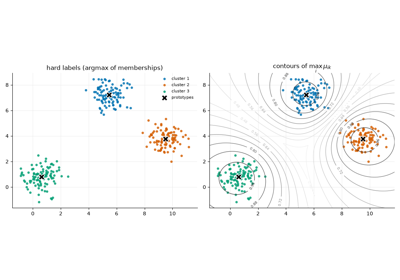
Fuzzy c-means: memberships and the fuzziness exponent
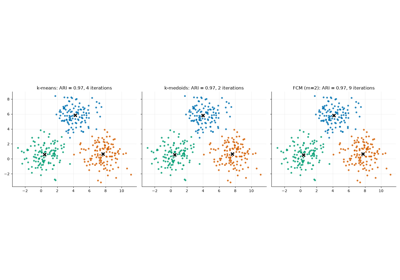
Hard versus fuzzy partitions: k-means, k-medoids, and FCM
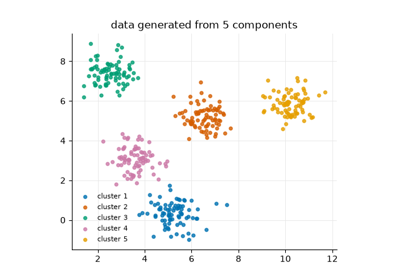
Choosing the number of clusters with validity indices
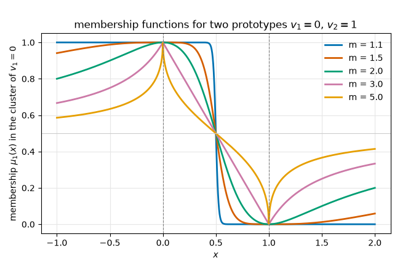
The fuzziness exponent m: from crisp cells to uniform memberships
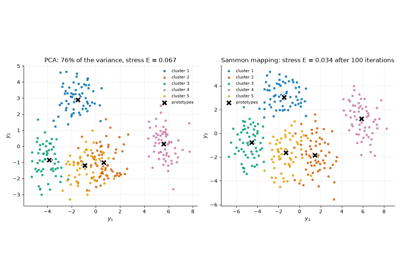
PCA versus Sammon mapping: preserving variance or distances
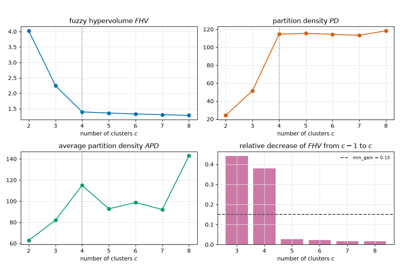
Number of clusters: volume-based validity and fuzzy cluster similarity
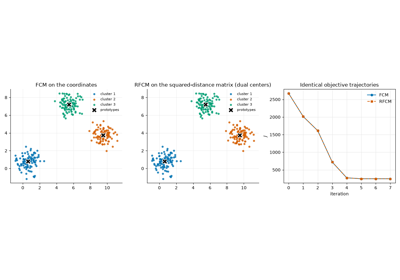
Relational fuzzy c-means and NERF for non-Euclidean data
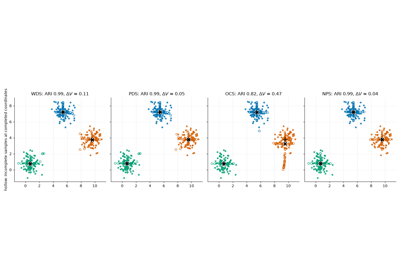
Clustering incomplete data: the four strategies of Hathaway and Bezdek
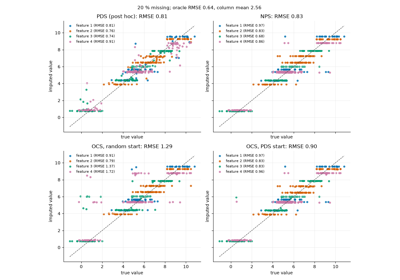
Imputation by clustering: accuracy of the completed values
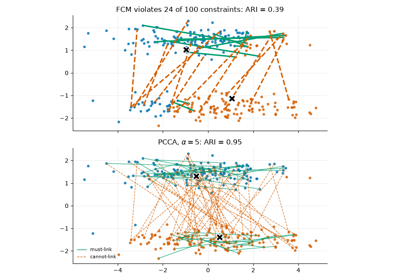
Pairwise constraints: must-link, cannot-link and competitive agglomeration