
fuzzyclust.timeseries.make_lorenz#
- fuzzyclust.timeseries.make_lorenz(n_samples=5000, dt=0.01, sigma=10.0, rho=28.0, beta=2.6666666666666665, x0=(1.0, 1.0, 1.0), discard=1000)[source]#
Trajectory of the Lorenz system (RK4, fixed step).
\[\dot x = \sigma(y-x),\quad \dot y = x(\rho-z)-y,\quad \dot z = xy-\beta z .\]- Returns:
- X
ndarrayofshape(n_samples, 3) State trajectory after the transient of
discardsteps.
- X
Examples
>>> from fuzzyclust.timeseries import make_lorenz
>>> make_lorenz(n_samples=100).shape
(100, 3)
Examples using fuzzyclust.timeseries.make_lorenz#
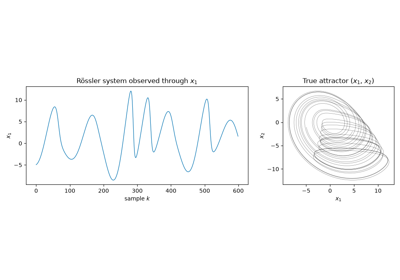
State-space reconstruction and prediction of a chaotic time series
State-space reconstruction and prediction of a chaotic time series