
fuzzyclust.timeseries.select_model_order#
- fuzzyclust.timeseries.select_model_order(y, u=None, max_na=4, max_nb=0, **kwargs)[source]#
Convenience wrapper of
fnn_model_order()returning only the selected orders.- Parameters:
- y, uarray_like
ofshape(T,) Output and (optional) input sequences.
- max_na, max_nb
int Largest orders considered.
- **kwargs
Further keyword arguments of
fnn_model_order()(n_clusters,threshold,fnn_tol,m,scale,random_state).
- y, uarray_like
- Returns:
- n_a, n_b
int Selected numbers of lagged outputs and inputs. For a scalar time series (
u=None)n_ais the embedding dimension andn_bis0.
- n_a, n_b
Examples
>>> from fuzzyclust.timeseries import select_model_order, make_nonlinear_io_system
>>> u, y = make_nonlinear_io_system(n_samples=600, random_state=0)
>>> select_model_order(y, u, max_na=2, max_nb=2, n_clusters=4, random_state=0)
(1, 2)
Examples using fuzzyclust.timeseries.select_model_order#
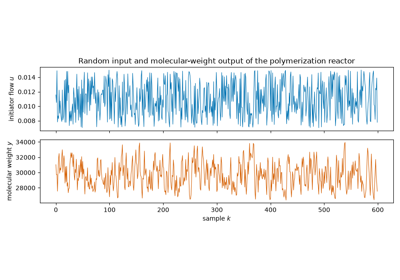
Model-order selection by false nearest neighbors with a cluster-based threshold
Model-order selection by false nearest neighbors with a cluster-based threshold