
fuzzyclust.models.SupervisedFuzzyClassifier#
- class fuzzyclust.models.SupervisedFuzzyClassifier(n_clusters=3, m=2.0, gamma=0.0, var_floor=1e-06, normalize_density=True, tol=0.0001, max_iter=300, init='kmeans++', n_init=3, random_state=None, verbose=0)[source]#
Bases:
ClassifierMixin,BaseFuzzyClustererFuzzy rule-based classifier identified by supervised Gath–Geva type clustering.
Every cluster is a rule with axis-parallel Gaussian antecedents and a class-probability vector as consequent,
\[r_i:\ \text{If } x_1 \text{ is } A_{i1}(x_1) \text{ and } \dots \text{ and } x_n \text{ is } A_{in}(x_n) \text{ then } \hat y = c_1 \text{ with } P(c_1\mid r_i), \dots,\ \hat y = c_C \text{ with } P(c_C\mid r_i)\ [w_i],\]so a rule may describe several classes and a class may need several rules (the number of rules \(R\) can exceed the number of classes \(C\)). The classifier is a quadratic Bayes classifier whose class-conditional densities are mixtures of axis-parallel Gaussians. The clustering uses the class labels: the distance of a labeled sample to a cluster is the reciprocal of the probability that the cluster generated both the input and the label [1].
- Parameters:
- n_clusters
int, default=3 Number of rules \(R\) (may be larger than the number of classes).
- m
float, default=2.0 Fuzziness exponent.
- gamma
float, default=0.0 Variance regularization \(\gamma\in[0,1]\): every antecedent variance is shrunk toward the variance of the feature, \(\sigma^2_{ij}\leftarrow(1-\gamma)\sigma^2_{ij}+\gamma\,\mathrm{var}(x_j)\) (the diagonal analog of the covariance regularization of
GG). A small value (0.05–0.2) prevents the collapse of a rule onto a few samples, a known weakness of the exponential distance.- var_floor
float, default=1e-6 Lower bound of the antecedent variances relative to the feature variances.
- normalize_densitybool, default=True
True: the Gaussians of the distance carry their normalizing constants, so \(1/D^2_{ik}\) is the joint probability \(p(\mathbf{x}_k, y_k, r_i)\) (the Gath–Geva distance of eq. (5) and the rule weights of eq. (18) in [1] contain these constants, and for \(m=2\) the clustering is then the EM algorithm of the mixture).False: the constants are dropped during clustering, which is eq. (20) of [1] literally; clusters with small variances are then not favored by the distance. Classification always uses the weights \(w_i\) of eq. (18).- tol
float, default=1e-4 - max_iter
int, default=300 - init{“random”, “kmeans++”}
orndarray, default=”kmeans++” - n_init
int, default=3 Number of random restarts; the run with the largest log-likelihood \(\sum_k\log\sum_i 1/D^2_{ik}\) is kept (ignored when
initis an array).- random_state
int,RandomStateinstanceorNone, default=None - verbose
int, default=0
- n_clusters
- Attributes:
- classes_
ndarrayofshape(n_classes,) - cluster_centers_
ndarrayofshape(n_clusters,n_features) Centers \(v_{ij}\) of the Gaussian antecedent sets.
- input_variances_
ndarrayofshape(n_clusters,n_features) Variances \(\sigma^2_{ij}\).
- class_probs_
ndarrayofshape(n_clusters,n_classes) Consequents \(P(c_j\mid r_i)\).
- priors_
ndarrayofshape(n_clusters,) \(P(r_i)\).
- rule_weights_
ndarrayofshape(n_clusters,) \(w_i = P(r_i)\prod_j (2\pi\sigma^2_{ij})^{-1/2}\).
- log_likelihood_
float \(\sum_k\log\sum_i 1/D^2_{ik}\) of the kept run.
- membership_, labels_, distances_, objective_, objective_history_, n_iter_
See
BaseFuzzyClusterer(labels_are cluster indices of the training samples, not classes).
- classes_
Notes
The distance of \(\mathbf{z}_k=[\mathbf{x}_k^T\,y_k]^T\) to rule \(i\) is
\[\frac{1}{D^2_{ik}} = P(r_i)\prod_{j=1}^{n}\frac{1}{\sqrt{2\pi\sigma^2_{ij}}} \exp\!\Big(-\tfrac12\frac{(x_{jk}-v_{ij})^2}{\sigma^2_{ij}}\Big)\;P(c_j=y_k\mid r_i),\]the Gath–Geva distance of the inputs multiplied by the probability that the rule describes the class of the sample (eq. 20 of [1], written with the normalizing constants of the Gaussians so that \(1/D^2_{ik}\) is the joint probability \(p(\mathbf{x}_k, y_k, r_i)\); the constants are exactly the rule weights \(w_i\) of the paper). The updates are
\[\mathbf{v}_i=\frac{\sum_k\mu_{ik}^m\mathbf{x}_k}{\sum_k\mu_{ik}^m},\quad \sigma^2_{ij}=\frac{\sum_k\mu_{ik}^m(x_{jk}-v_{ij})^2}{\sum_k\mu_{ik}^m},\quad P(c_j\mid r_i)=\frac{\sum_{k:\,y_k=c_j}\mu_{ik}^m}{\sum_k\mu_{ik}^m},\quad P(r_i)=\frac1N\sum_k\mu_{ik}^m ,\]followed by the usual membership update. Classification of a new input aggregates the rules with the normalized firing strengths \(\beta_i(\mathbf{x})=w_i\prod_j A_{ij}(x_j)\):
\[P(c_j\mid\mathbf{x}) = \frac{\sum_i \beta_i(\mathbf{x})\,P(c_j\mid r_i)} {\sum_i\beta_i(\mathbf{x})},\qquad \hat y = \arg\max_j P(c_j\mid\mathbf{x}).\]Hence
predict_proba()returns class posteriors (as any scikit-learn classifier), not cluster memberships; the latter are available throughcluster_membership().References
Examples
>>> from fuzzyclust.datasets import load_iris
>>> from fuzzyclust.models import SupervisedFuzzyClassifier
>>> iris = load_iris()
>>> clf = SupervisedFuzzyClassifier(n_clusters=3, random_state=0).fit(iris.data, iris.target)
>>> clf.predict_proba(iris.data).shape
(150, 3)
>>> clf.score(iris.data, iris.target) > 0.9
True
- cluster_membership(X, y=None)[source]#
Memberships in the rules (clusters),
(n_samples, n_clusters).Without
y: normalized firing strengths \(p(r_i\mid\mathbf{x})\). Withy: the class term enters as during fitting, \(p(r_i\mid\mathbf{x}, y)\).
- feature_importance(criterion='det')[source]#
Separability \(J_{-j}\) of the rule base when feature \(j\) is left out.
The feature with the largest \(J_{-j}\) is the one whose removal harms the separability least, i.e. the least needed feature; the step-wise elimination of Abonyi and Szeifert (2003) is implemented in
select_features_by_separability().- Returns:
- J_minus
ndarrayofshape(n_features_in_,)
- J_minus
- fit(X, y=None)[source]#
Identify the rules from labeled data.
- Parameters:
- Xarray_like
ofshape(n_samples,n_features) - yarray_like
ofshape(n_samples,) Class labels (any hashable values); required.
- Xarray_like
- Returns:
- self
object
- self
- fit_predict(X, y=None, **kwargs)[source]#
Fit and return the predicted class labels of the training samples.
- fit_transform(X, y=None, **fit_params)[source]#
Fit to data, then transform it.
Fits transformer to X and y with optional parameters fit_params and returns a transformed version of X.
- Parameters:
- Xarray_like
ofshape(n_samples,n_features) Input samples.
- yarray_like
ofshape(n_samples,)or(n_samples,n_outputs), default=None Target values (None for unsupervised transformations).
- **fit_params
dict Additional fit parameters. Pass only if the estimator accepts additional params in its fit method.
- Xarray_like
- Returns:
- interclass_separability(features=None, criterion='det')[source]#
Fisher interclass separability of the rules, \(J=\det\mathbf{F}_B/\det\mathbf{F}_W\).
With the rule priors \(P(r_i)\), centers \(\mathbf{v}_i\) and (diagonal) covariances \(\mathbf{F}_i=\operatorname{diag}(\sigma^2_{i1},\dots)\),
\[\mathbf{F}_W=\sum_i P(r_i)\mathbf{F}_i,\qquad \mathbf{F}_B=\sum_i P(r_i)(\mathbf{v}_i-\mathbf{v}_0)(\mathbf{v}_i-\mathbf{v}_0)^T,\qquad \mathbf{v}_0=\sum_i P(r_i)\mathbf{v}_i\](eq. 27–28 of Abonyi and Szeifert (2003)). A large \(J\) means well separated, compact rules.
featuresrestricts the computation to a subset of the features; the importance of a feature is the value of \(J\) obtained without it (seefeature_importance()).\(\mathbf{F}_B\) has rank at most \(R-1\), so for fewer rules than features its determinant is zero; the product of its \(\min(R-1, n)\) largest eigenvalues (pseudo-determinant) is used in that case, which keeps \(J\) comparable between feature subsets of the same size. With
criterion="trace"the classical Fisher criterion \(\operatorname{tr}(\mathbf{F}_W^{-1}\mathbf{F}_B)\) is returned instead.
Examples using fuzzyclust.models.SupervisedFuzzyClassifier#
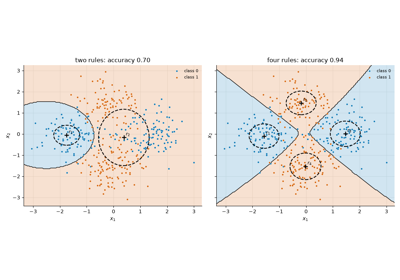
Supervised fuzzy clustering: classifier rules that carry class probabilities