
fuzzyclust.timeseries.make_mixed_input_system#
- fuzzyclust.timeseries.make_mixed_input_system(n_samples=1000, noise=0.1, n_dummy=2, random_state=None)[source]#
Regression problem with one discrete and several continuous inputs.
Example B of Girimonte, Babuška & Abonyi:
\[\begin{split}y = \begin{cases} x_1^2 + \epsilon & \text{if } x_2 = 1,\\ x_4^2 + x_3 + \epsilon & \text{if } x_2 = 0,\end{cases} \qquad \epsilon\sim\mathcal{N}(0, \text{noise}^2),\end{split}\]with \(x_1, x_3, x_4\sim U[0,1]\), the switching input \(x_2\in\{0,1\}\) drawn at random, and
n_dummyirrelevant uniform inputs appended (\(x_5, x_6\)). The correct structure is \(\{x_1, x_2, x_3, x_4\}\).- Returns:
Examples
>>> from fuzzyclust.timeseries import make_mixed_input_system
>>> X, y, disc = make_mixed_input_system(n_samples=50, random_state=0)
>>> X.shape, disc.tolist()
((50, 6), [False, True, False, False, False, False])
Examples using fuzzyclust.timeseries.make_mixed_input_system#
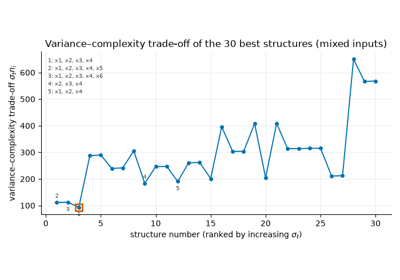
Model-free structure selection with mixed discrete and continuous inputs
Model-free structure selection with mixed discrete and continuous inputs