
fuzzyclust.validity.scan_n_clusters#
- fuzzyclust.validity.scan_n_clusters(estimator, X, n_clusters_range=range(2, 11), indices=None)[source]#
Fit the estimator for several numbers of clusters and tabulate validity indices.
- Parameters:
- estimator
fittedorunfittedfuzzyclustestimator Cloned and refitted for every value of
n_clusters.- Xarray_like
ofshape(n_samples,n_features) - n_clusters_rangeiterable
ofint, default=range(2, 11) - indicesiterable
ofstr,optional
- estimator
- Returns:
pandas.DataFrameIndexed by
n_clusterswith one column per index.
Examples
>>> from fuzzyclust.cluster import FCM
>>> from fuzzyclust.datasets import make_fuzzy_blobs
>>> from fuzzyclust.validity import scan_n_clusters
>>> X, _ = make_fuzzy_blobs(random_state=0)
>>> table = scan_n_clusters(FCM(random_state=0), X, range(2, 6), indices=["PC", "XB"])
>>> list(table.columns)
['PC', 'XB']
Examples using fuzzyclust.validity.scan_n_clusters#
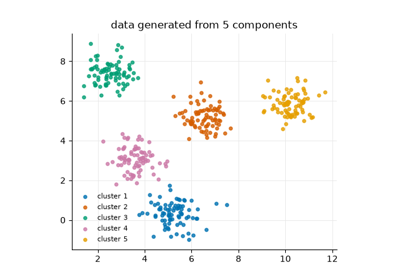
Choosing the number of clusters with validity indices
Choosing the number of clusters with validity indices
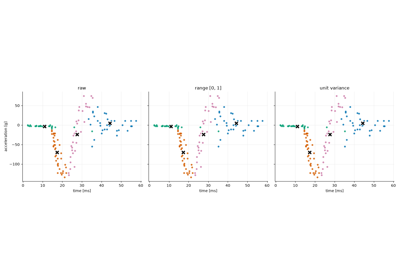
Feature scaling on real data: the motorcycle data set
Feature scaling on real data: the motorcycle data set
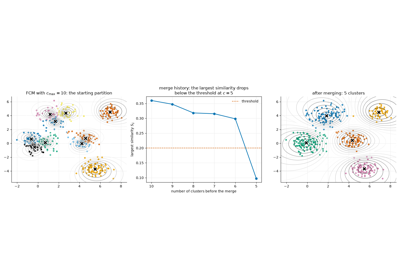
Three routes to the number of clusters: merging, validity scan, and stability
Three routes to the number of clusters: merging, validity scan, and stability
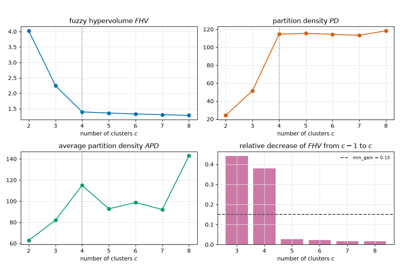
Number of clusters: volume-based validity and fuzzy cluster similarity
Number of clusters: volume-based validity and fuzzy cluster similarity