
fuzzyclust.models.plot_membership_functions#
- fuzzyclust.models.plot_membership_functions(model, X=None, feature_names=None, axes=None, n_points=300, ranges=None)[source]#
Gaussian antecedent membership functions \(A_{ij}(x_j)\) of every rule, one panel per input.
- Parameters:
- model
fittedTakagiSugeno,ModifiedGGorSupervisedFuzzyClassifier - Xarray_like
ofshape(n_samples,n_features),optional Data used to set the plotting range of every feature (otherwise centers \(\pm 3\sigma\)), and drawn as a rug.
- feature_namessequence
ofstr,optional - axes
arrayofmatplotlibAxes,optional One axis per antecedent feature.
- n_points
int, default=300 - rangessequence
of(lo,hi),optional Explicit plotting ranges per antecedent feature.
- model
- Returns:
- axes
ndarrayofmatplotlibAxes
- axes
Examples using fuzzyclust.models.plot_membership_functions#
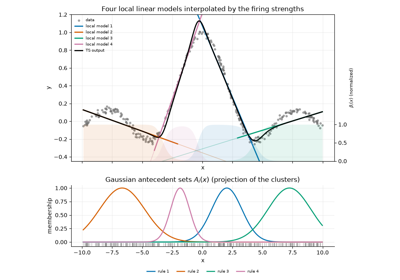
Takagi–Sugeno model of a static nonlinearity: clusters become rules
Takagi–Sugeno model of a static nonlinearity: clusters become rules
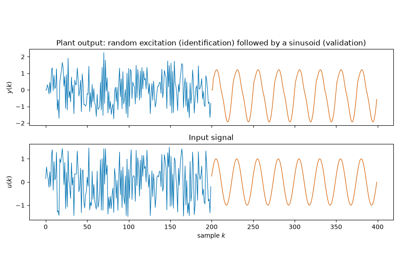
Identification of a nonlinear dynamic system with free-run validation
Identification of a nonlinear dynamic system with free-run validation
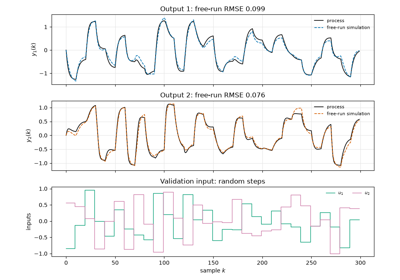
MIMO Takagi–Sugeno model with local MIMO ARX consequents
MIMO Takagi–Sugeno model with local MIMO ARX consequents
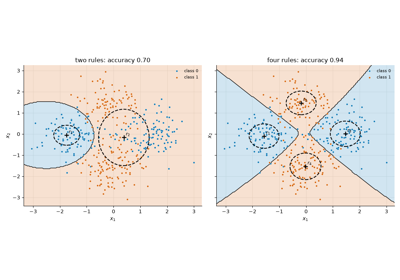
Supervised fuzzy clustering: classifier rules that carry class probabilities
Supervised fuzzy clustering: classifier rules that carry class probabilities