
fuzzyclust.semisupervised.PairwiseConstrainedFCM#
- class fuzzyclust.semisupervised.PairwiseConstrainedFCM(n_clusters=3, alpha=1.0, agglomeration=0.0, agglomeration_decay=10.0, min_cardinality=1.0, m=2.0, tol=0.0001, max_iter=300, init='random', n_init=1, random_state=None, verbose=0)[source]#
Bases:
BaseFuzzyClustererFuzzy clustering with pairwise constraints, PCCA (Grira, Crucianu, and Boujemaa).
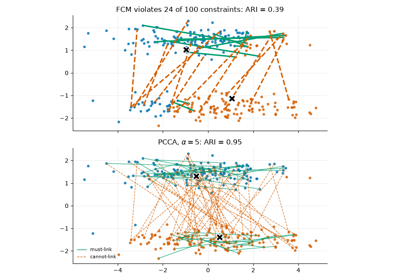
Knowledge about the data comes as pairs: two samples that must end up in the same cluster (must-link) or in different clusters (cannot-link). Such constraints are far easier to collect than class labels – a user only has to say whether two images belong together – and they need no agreed set of classes. The algorithm adds to the c-means functional a penalty for violated constraints, and (optionally) the competitive agglomeration term of Frigui and Krishnapuram, which lets the number of clusters shrink from an over-estimate to the number the data and the constraints support.
- Parameters:
- n_clusters
int, default=3 Number of clusters \(c\) (the initial, maximal number when
agglomeration > 0).- alpha
floator “auto”, default=1.0 Weight \(\alpha\ge0\) of the constraint penalty, in the units of the squared distances.
"auto"renews it at every iteration as \(\sum_{ik}\mu_{ik}^2D_{ik}^2/|\mathcal{M}\cup\mathcal{C}|\), so that the few constraints weigh as much as the data. The published rule, \(\alpha = N\sum_{ik}\mu_{ik}^2D_{ik}^2 / \big(|\mathcal{M}\cup\mathcal{C}|\sum_{ik}\mu_{ik}^2\big)\), also divides by the mean squared membership; the two coincide for a crisp partition.- agglomeration
float, default=0.0 \(\eta_0\) of the competitive agglomeration term;
0keeps the number of clusters fixed (pure pairwise-constrained FCM).- agglomeration_decay
float, default=10.0 Time constant \(\tau\) of the schedule \(\eta(l)=\eta_0 e^{-l/\tau}\).
- min_cardinality
float, default=1.0 A cluster whose fuzzy cardinality \(N_i=\sum_k\mu_{ik}\) falls below this value is discarded (only when
agglomeration > 0).- m
float, default=2.0 The paper’s updates are derived for \(m=2\); other values raise.
- tol
float, default=1e-4 - max_iter
int, default=300 - init{“random”, “kmeans++”}
orndarray, default=”random” - n_init
int, default=1 - random_state
int,RandomStateinstanceorNone, default=None - verbose
int, default=0
- n_clusters
- Attributes:
- cluster_centers_
ndarrayofshape(n_clusters_,n_features) - membership_
ndarrayofshape(n_samples,n_clusters_) - labels_
ndarrayofshape(n_samples,) - n_clusters_
int Number of clusters at convergence (
n_clustersunless clusters were discarded).- must_link_, cannot_link_
ndarrayofshape(n_pairs, 2) The validated constraints.
- must_link_satisfied_, cannot_link_satisfied_
float Share of constraints satisfied by the hard partition.
- alpha_
float Penalty weight at the last iteration.
- cardinalities_
ndarrayofshape(n_clusters_,) Fuzzy cardinalities \(N_i\) of the final clusters.
- covariances_
ndarrayofshape(n_clusters_,n_features,n_features) - distances_, objective_, objective_history_, n_iter_
See
BaseFuzzyClusterer.
- cluster_centers_
Notes
With the sets \(\mathcal{M}\) of must-link and \(\mathcal{C}\) of cannot-link pairs the objective is
\[J = \sum_{i=1}^{c}\sum_{k=1}^{N}\mu_{ik}^2 D_{ik}^2 + \alpha\Big[\sum_{(k,l)\in\mathcal{M}}\sum_{i=1}^{c}\sum_{j\ne i}\mu_{ik}\mu_{jl} + \sum_{(k,l)\in\mathcal{C}}\sum_{i=1}^{c}\mu_{ik}\mu_{il}\Big] - \beta\sum_{i=1}^{c}N_i^2,\qquad N_i=\sum_{k=1}^{N}\mu_{ik},\]the bracket being the expected number of violated constraints and the last term the competitive agglomeration bias. The necessary conditions give a membership that is the FCM membership plus two corrections,
\[\mu_{ik} = \frac{1/D_{ik}^2}{\sum_j 1/D_{jk}^2} + \frac{\alpha}{2D_{ik}^2}\big(\bar{C}_k - C_{ik}\big) + \frac{\beta}{D_{ik}^2}\big(N_i - \bar{N}_k\big),\]where \(C_{ik}=\sum_{l:(k,l)\in\mathcal{M}}(1-\mu_{il})+\sum_{l:(k,l)\in\mathcal{C}}\mu_{il}\) is the violation cost of placing \(k\) in cluster \(i\), and \(\bar C_k\), \(\bar N_k\) are the \(1/D^2_{jk}\)-weighted means of \(C_{jk}\) and \(N_j\) over the clusters. A cluster that violates fewer constraints than average gains membership; a cluster larger than average gains membership when \(\beta>0\). The corrections can push a membership below zero; as in competitive agglomeration, negative values are clipped and the row renormalized. The agglomeration weight follows Frigui and Krishnapuram’s schedule \(\beta(l)=\eta_0e^{-l/\tau}\sum_{ik}\mu_{ik}^2D_{ik}^2/\sum_iN_i^2\), and clusters with \(N_i<\)
min_cardinalityare removed. The prototypes are the usual FCM means. New samples carry no constraints and receive FCM memberships.References
[1]N. Grira, M. Crucianu, N. Boujemaa, “Fuzzy clustering with pairwise constraints for knowledge-driven image categorization”, IEE Proceedings – Vision, Image and Signal Processing 153(3), 299–304, 2006.
[2]H. Frigui, R. Krishnapuram, “Clustering by competitive agglomeration”, Pattern Recognition 30(7), 1109–1119, 1997.
Examples
>>> from fuzzyclust.semisupervised import PairwiseConstrainedFCM, make_pairwise_constraints
>>> from fuzzyclust.datasets import make_fuzzy_blobs
>>> X, y = make_fuzzy_blobs(random_state=0)
>>> ml, cl = make_pairwise_constraints(y, n_must_link=20, n_cannot_link=20, random_state=0)
>>> pcca = PairwiseConstrainedFCM(n_clusters=3, random_state=0).fit(X, must_link=ml, cannot_link=cl)
>>> pcca.membership_.shape, pcca.must_link_.shape
((300, 3), (20, 2))
Examples using fuzzyclust.semisupervised.PairwiseConstrainedFCM#
Pairwise constraints: must-link, cannot-link and competitive agglomeration