
Note
Go to the end to download the full example code or to run this example in your browser via Binder.
Clustering a drifting stream chunk by chunk with partial_fit#
Single-pass and online FCM need only one chunk in memory, so they can
consume a stream: partial_fit processes one chunk and keeps a
summary of everything seen so far (\(c\) weighted prototypes for
spFCM, all chunk prototypes for oFCM). Both summaries treat the stream as
stationary: an observation from the first chunk counts as much as one
from the last. When the clusters drift, the summary lags behind. This
example sends a stream of 40 chunks through both algorithms while the
three cluster centers move along straight lines, and measures the
distance of the model’s prototypes from the current true centers. A
forgetting factor \(\lambda\) (forgetting_factor, an addition to
the published spFCM) multiplies the carried weights before every chunk,
so that old data fade geometrically; the parameter study shows that the
right \(\lambda\) balances lag against noise and depends on how fast
the stream drifts.
import matplotlib.pyplot as plt
import numpy as np
from scipy.optimize import linear_sum_assignment
from scipy.spatial.distance import cdist

from fuzzyclust.large import OnlineFCM, SinglePassFCM, make_drifting_stream
from fuzzyclust.plotting import PALETTE


def tracking_error(V, C):
    """Mean distance between matched prototypes and true centers."""
    D = cdist(V, C)
    r, c = linear_sum_assignment(D)
    return float(D[r, c].mean())


stream = list(make_drifting_stream(n_chunks=40, chunk_size=500, n_clusters=3, drift=0.12, random_state=0))
true_centers = np.array([C for _, _, C in stream])
Feeding the stream#
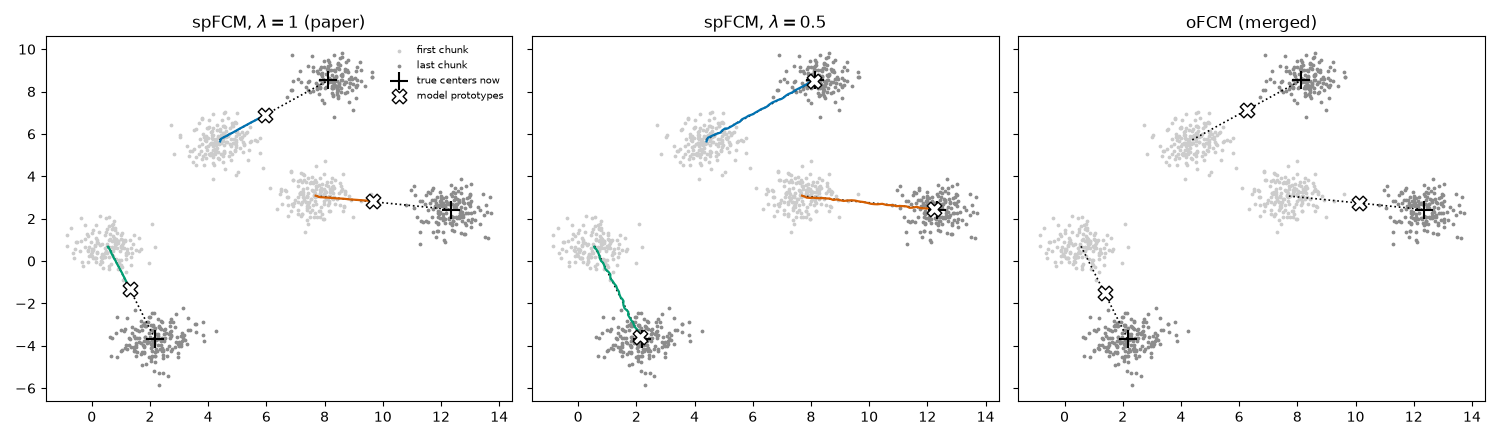
Every model sees the chunks in order and is queried after each one. The
published spFCM (\(\lambda=1\)) and oFCM summarize the whole past;
spFCM with \(\lambda=0.5\) keeps an effective memory of about two
chunks. The chunk prototypes of oFCM (chunk_centers_) are a by-product:
FCM on each chunk alone, the most recent but also the noisiest estimate.
# [snippet:stream]
models = {
    "spFCM, $\\lambda=1$ (paper)": SinglePassFCM(n_clusters=3, chunk_size=500, random_state=0),
    "spFCM, $\\lambda=0.5$": SinglePassFCM(n_clusters=3, chunk_size=500, forgetting_factor=0.5, random_state=0),
    "oFCM (merged)": OnlineFCM(n_clusters=3, chunk_size=500, random_state=0),
}
errors = {name: [] for name in models}
errors["oFCM, last chunk only"] = []
for Xc, _, C in stream:
    for name, model in models.items():
        model.partial_fit(Xc)
        errors[name].append(tracking_error(model.cluster_centers_, C))
    errors["oFCM, last chunk only"].append(tracking_error(models["oFCM (merged)"].chunk_centers_[-1], C))
# [/snippet:stream]

fig, axes = plt.subplots(1, 3, figsize=(15, 4.4), sharex=True, sharey=True)
first, last = stream[0][0], stream[-1][0]
for ax, name in zip(axes, models, strict=True):
    ax.scatter(*first.T, s=3, color="0.8", label="first chunk")
    ax.scatter(*last.T, s=3, color="0.55", label="last chunk")
    for i in range(3):
        ax.plot(true_centers[:, i, 0], true_centers[:, i, 1], color="black", ls=":", lw=1.2)
        traj = models[name].chunk_centers_ if "spFCM" in name else None
        if traj is not None:
            ax.plot(traj[:, i, 0], traj[:, i, 1], color=PALETTE[i], lw=1.6)
    ax.scatter(*true_centers[-1].T, marker="+", s=160, color="black", zorder=5, label="true centers now")
    ax.scatter(*models[name].cluster_centers_.T, marker="X", s=110, color="white", edgecolor="black",
               zorder=6, label="model prototypes")
    ax.set_title(name)
axes[0].legend(frameon=False, fontsize=7, loc="best")
plt.tight_layout()
Tracking error along the stream#
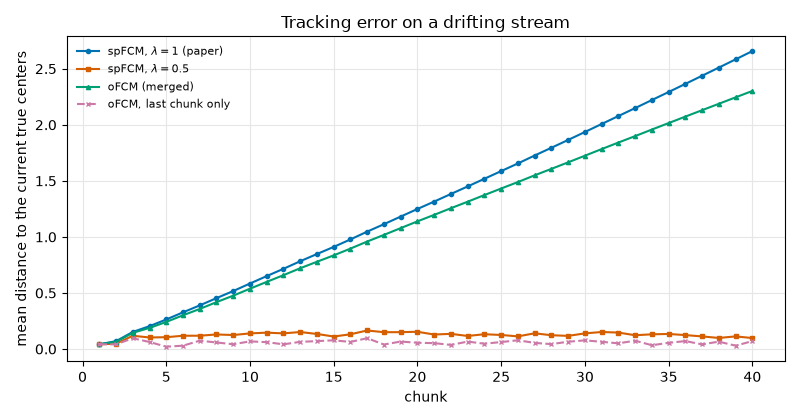
The published spFCM and oFCM fall behind linearly: their prototypes sit near the time average of the centers, which trails the current centers by half the distance traveled. With forgetting, spFCM settles at a constant small lag; the single-chunk FCM has no lag but the full sampling noise of 500 samples.
fig, ax = plt.subplots(figsize=(8, 4.2))
styles = ["o-", "s-", "^-", "x--"]
for j, (name, err) in enumerate(errors.items()):
    ax.plot(np.arange(1, len(err) + 1), err, styles[j], ms=3, color=PALETTE[j], label=name)
ax.set_xlabel("chunk")
ax.set_ylabel("mean distance to the current true centers")
ax.set_title("Tracking error on a drifting stream")
ax.legend(frameon=False, fontsize=8)
ax.grid(True, color="0.9")
plt.tight_layout()
Parameter study: forgetting factor against drift speed#
The forgetting factor trades lag for noise. Small chunks (200 samples) make the noise visible. Without drift, a long memory (\(\lambda\) close to one) is best, because every observation helps average out the noise; the faster the drift, the smaller the best \(\lambda\). The error is averaged over the second half of the stream, after the start-up.
# [snippet:scan]
lambdas = (0.0, 0.25, 0.5, 0.75, 0.9, 0.95, 1.0)
drifts = (0.0, 0.02, 0.05, 0.15)
table = np.zeros((len(drifts), len(lambdas)))
for a, drift in enumerate(drifts):
    chunks = list(make_drifting_stream(n_chunks=40, chunk_size=200, n_clusters=3, drift=drift, random_state=0))
    for b, lam in enumerate(lambdas):
        model = SinglePassFCM(n_clusters=3, chunk_size=200, forgetting_factor=lam, random_state=0)
        errs = []
        for Xc, _, C in chunks:
            errs.append(tracking_error(model.partial_fit(Xc).cluster_centers_, C))
        table[a, b] = np.mean(errs[20:])
# [/snippet:scan]

fig, ax = plt.subplots(figsize=(8, 4.2))
for a, drift in enumerate(drifts):
    ax.semilogy(lambdas, table[a], "o-", color=PALETTE[a], label=f"drift {drift} per chunk")
    b = int(np.argmin(table[a]))
    ax.scatter(lambdas[b], table[a, b], s=120, facecolors="none", edgecolors=PALETTE[a], linewidths=1.5)
ax.set_xlabel(r"forgetting factor $\lambda$")
ax.set_ylabel("mean tracking error (chunks 21-40)")
ax.set_title(r"The best $\lambda$ (circled) falls as the drift grows")
ax.legend(frameon=False, fontsize=8)
ax.grid(True, color="0.9", which="both")
plt.tight_layout()

for a, drift in enumerate(drifts):
    print(f"drift {drift:4.2f}: " + " ".join(f"{e:.3f}" for e in table[a]) +
          f"  best lambda = {lambdas[int(np.argmin(table[a]))]}")
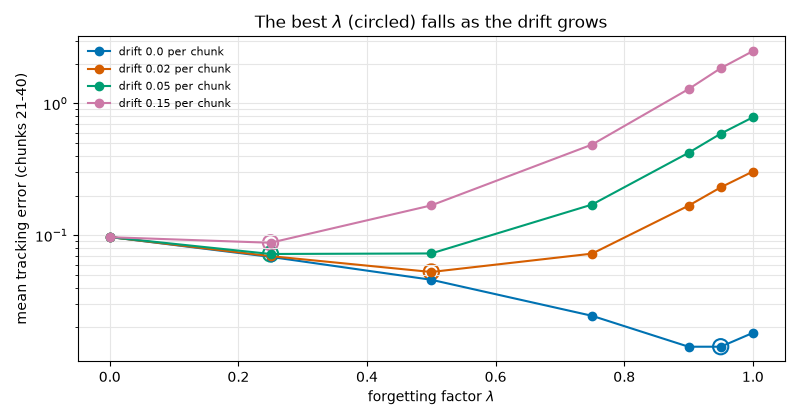
drift 0.00: 0.097 0.069 0.046 0.024 0.014 0.014 0.018  best lambda = 0.95
drift 0.02: 0.097 0.069 0.053 0.073 0.168 0.231 0.304  best lambda = 0.5
drift 0.05: 0.097 0.072 0.073 0.171 0.422 0.590 0.784  best lambda = 0.25
drift 0.15: 0.097 0.088 0.168 0.487 1.284 1.849 2.493  best lambda = 0.25
Take-away. partial_fit turns spFCM and oFCM into stream
clusterers with constant memory, but as published both assume that the
stream does not change: their prototypes describe the whole past and
trail drifting clusters by half the distance traveled. A forgetting
factor below one gives spFCM a finite memory of about
\(1/(1-\lambda)\) chunks and lets it follow the drift. Choose
\(\lambda\) near one for stationary data, around 0.5 for slow
drift, and smaller values (or larger chunks) when the clusters move
quickly; the chunk prototypes of oFCM show what a memoryless model sees.
Total running time of the script: (0 minutes 0.700 seconds)
