
Note
Go to the end to download the full example code or to run this example in your browser via Binder.
Fuzzy c-shells: circles as prototypes#
A ring has no interior points, so a point prototype placed at its center is far from every member, and FCM cannot tell concentric rings apart at all. Shell clustering describes cluster \(i\) by a center \(\mathbf{v}_i\) and a radius \(r_i\) and measures the distance of a sample as its deviation from the circle. The fuzzy c-spherical shells algorithm (FCSS) of Krishnapuram, Nasraoui and Frigui uses the algebraic distance \((\|\mathbf{x}_k-\mathbf{v}_i\|^2-r_i^2)^2\), which is quadratic in a reparametrized prototype and therefore has a closed-form weighted least-squares update; Davé’s original fuzzy c-shells (FCS) uses the radial distance \((\|\mathbf{x}_k-\mathbf{v}_i\|-r_i)^2\) and needs a Newton iteration per cluster. The example recovers the radii of concentric and of intersecting circles, compares the two algorithms, and shows why the initialization matters.
import matplotlib.pyplot as plt
import numpy as np
from scipy.optimize import linear_sum_assignment
from sklearn.metrics import adjusted_rand_score

from fuzzyclust import FCM
from fuzzyclust.datasets import make_rings
from fuzzyclust.extensions import FuzzyCShells, make_circles, plot_shells
from fuzzyclust.plotting import PALETTE, plot_membership_contours

Xr, yr = make_rings(n_samples_per_ring=150, radii=(1.0, 3.0), noise=0.1, random_state=0)
Xc, yc = make_circles(centers=((0.0, 0.0), (3.0, 1.0), (1.0, 3.5)), radii=(2.0, 1.2, 1.0),
                      n_samples_per_circle=120, noise=0.06, random_state=0)
true_c = np.array([[0.0, 0.0], [3.0, 1.0], [1.0, 3.5]])
true_r = np.array([2.0, 1.2, 1.0])


def match(model, centers, radii):
    """Center and radius errors after matching the shells to the true circles."""
    D = np.linalg.norm(model.cluster_centers_[:, None] - centers[None], axis=2)
    r, c = linear_sum_assignment(D)
    return D[r, c].max(), np.abs(model.radii_[r] - radii[c]).max()
Concentric rings and intersecting circles#
FCM halves the rings and finds nothing on the intersecting circles either. FCSS recovers the radii 1 and 3 of the rings to two decimals, and on three circles that intersect and partly cover each other it finds the centers and radii to within a few hundredths; points near an intersection share their membership. The concentric rings need several restarts (see the parameter study), whereas on the intersecting circles the hardened FCM start is already good enough.
# [snippet:fit]
fcm_r = FCM(n_clusters=2, random_state=0).fit(Xr)
fcss_r = FuzzyCShells(n_clusters=2, algorithm="fcss", n_init=5, random_state=0).fit(Xr)
fcss_c = FuzzyCShells(n_clusters=3, algorithm="fcss", random_state=0).fit(Xc)
print(f"rings: FCM ARI = {adjusted_rand_score(yr, fcm_r.labels_):.2f}, FCSS ARI = "
      f"{adjusted_rand_score(yr, fcss_r.labels_):.2f}, radii found {np.sort(fcss_r.radii_).round(2)} (true 1, 3)")
ce, re = match(fcss_c, true_c, true_r)
print(f"circles: FCSS ARI = {adjusted_rand_score(yc, fcss_c.labels_):.2f}, "
      f"largest center error {ce:.3f}, largest radius error {re:.3f}")
# [/snippet:fit]

fig, axes = plt.subplots(1, 3, figsize=(15, 4.6))
plot_membership_contours(fcm_r, Xr, ax=axes[0], labels=False)
axes[0].set_aspect("equal")
axes[0].set_title(f"FCM on two rings: ARI = {adjusted_rand_score(yr, fcm_r.labels_):.2f}")
plot_shells(Xr, fcss_r, ax=axes[1])
axes[1].set_title(f"FCSS on two rings: radii {np.sort(fcss_r.radii_).round(2)}")
plot_shells(Xc, fcss_c, ax=axes[2])
axes[2].set_title(f"FCSS on three intersecting circles: ARI = {adjusted_rand_score(yc, fcss_c.labels_):.2f}")
plt.tight_layout()
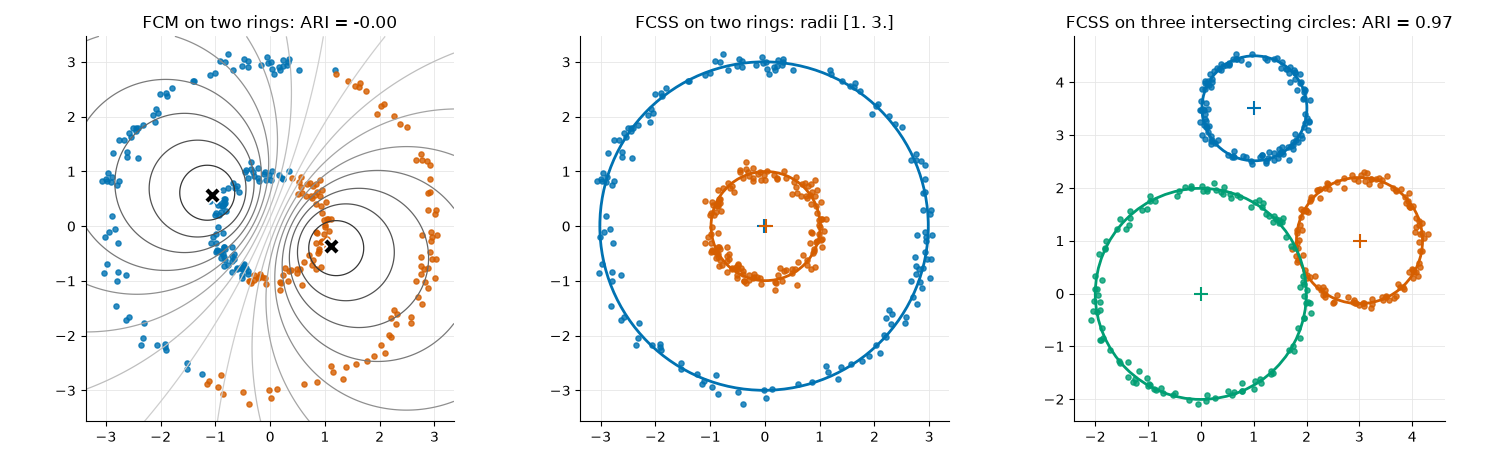
rings: FCM ARI = -0.00, FCSS ARI = 1.00, radii found [1. 3.] (true 1, 3)
circles: FCSS ARI = 0.97, largest center error 0.015, largest radius error 0.007
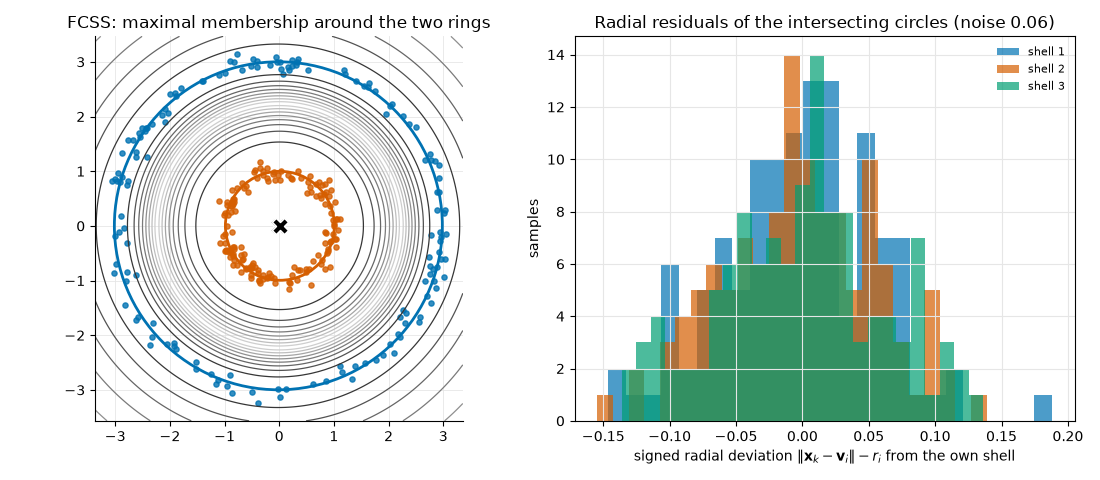
The membership of a point in a shell depends only on its radial deviation from the circle, so the contours of the maximal membership are rings around the fitted circles, and the membership drops toward the center of a circle as well as away from it.
fig, axes = plt.subplots(1, 2, figsize=(11, 4.8))
plot_membership_contours(fcss_r, Xr, ax=axes[0], labels=False)
for i, (v, r) in enumerate(zip(fcss_r.cluster_centers_, fcss_r.radii_, strict=True)):
    axes[0].add_patch(plt.Circle(v, r, fill=False, lw=2, color=PALETTE[i]))
axes[0].set_aspect("equal")
axes[0].set_title("FCSS: maximal membership around the two rings")
E = fcss_c.radial_deviation(Xc)
own = E[np.arange(len(Xc)), fcss_c.labels_]
for i in range(3):
    axes[1].hist(own[fcss_c.labels_ == i], bins=25, color=PALETTE[i], alpha=0.7, label=f"shell {i + 1}")
axes[1].set_xlabel(r"signed radial deviation $\|\mathbf{x}_k-\mathbf{v}_i\|-r_i$ from the own shell")
axes[1].set_ylabel("samples")
axes[1].set_title("Radial residuals of the intersecting circles (noise 0.06)")
axes[1].legend(frameon=False, fontsize=8)
axes[1].grid(True, color="0.9")
plt.tight_layout()
Parameter study I: initialization and restarts#
Shell clustering has a notorious local minimum: one big circle through
everything, with the other shells fitting noise. The default start, the
hardened FCM partition, works well when the shells are separate or
intersect (the FCM groups then lie on different circles), but on
concentric rings FCM halves every ring and both shells converge to the
mean radius. Random restarts (n_init) escape this trap because the
best run by the objective is kept: with ten restarts the rings are found
from every seed. On concentric rings, random point prototypes need fewer
restarts than the FCM start, which spends its first run on the halved
rings.
fig, axes = plt.subplots(1, 3, figsize=(15, 4.6))
for ax, n_init in zip(axes[:2], (1, 5), strict=True):
    model = FuzzyCShells(n_clusters=2, n_init=n_init, random_state=0).fit(Xr)
    plot_shells(Xr, model, ax=ax)
    ax.set_title(f"rings, init='fcm', n_init = {n_init}: radii {np.sort(model.radii_).round(2)}, J = {model.objective_:.1f}")
seeds = range(10)
n_inits = (1, 3, 5, 10)
for j, (init, color) in enumerate((("fcm", PALETTE[0]), ("random", PALETTE[1]), ("kmeans++", PALETTE[2]))):
    means, lows, highs = [], [], []
    for n_init in n_inits:
        aris = [adjusted_rand_score(yr, FuzzyCShells(n_clusters=2, init=init, n_init=n_init, random_state=s).fit(Xr).labels_)
                for s in seeds]
        means.append(np.mean(aris))
        lows.append(np.min(aris))
        highs.append(np.max(aris))
    pos = np.array(n_inits) * (1.0 + 0.08 * (j - 1))  # small horizontal offset per initialization
    axes[2].errorbar(pos, means, yerr=[np.array(means) - lows, np.array(highs) - means], fmt="o-", color=color,
                     capsize=3, lw=1.2, label=f"init = '{init}'")
    print(f"rings, init = '{init}': mean ARI over 10 seeds for n_init = {n_inits}: {np.round(means, 2)}")
axes[2].set_xscale("log")
axes[2].set_xticks(n_inits, [str(n) for n in n_inits])
axes[2].set_xlabel("number of restarts n_init")
axes[2].set_ylabel("adjusted Rand index (mean and range over 10 seeds)")
axes[2].set_title("Rings: how often the two shells are found")
axes[2].legend(frameon=False, fontsize=8)
axes[2].grid(True, color="0.9")
plt.tight_layout()
print("intersecting circles, n_init = 1: ARI with init='fcm' "
      f"{adjusted_rand_score(yc, FuzzyCShells(n_clusters=3, init='fcm', random_state=0).fit(Xc).labels_):.2f}, "
      f"init='random' {adjusted_rand_score(yc, FuzzyCShells(n_clusters=3, init='random', random_state=0).fit(Xc).labels_):.2f}")
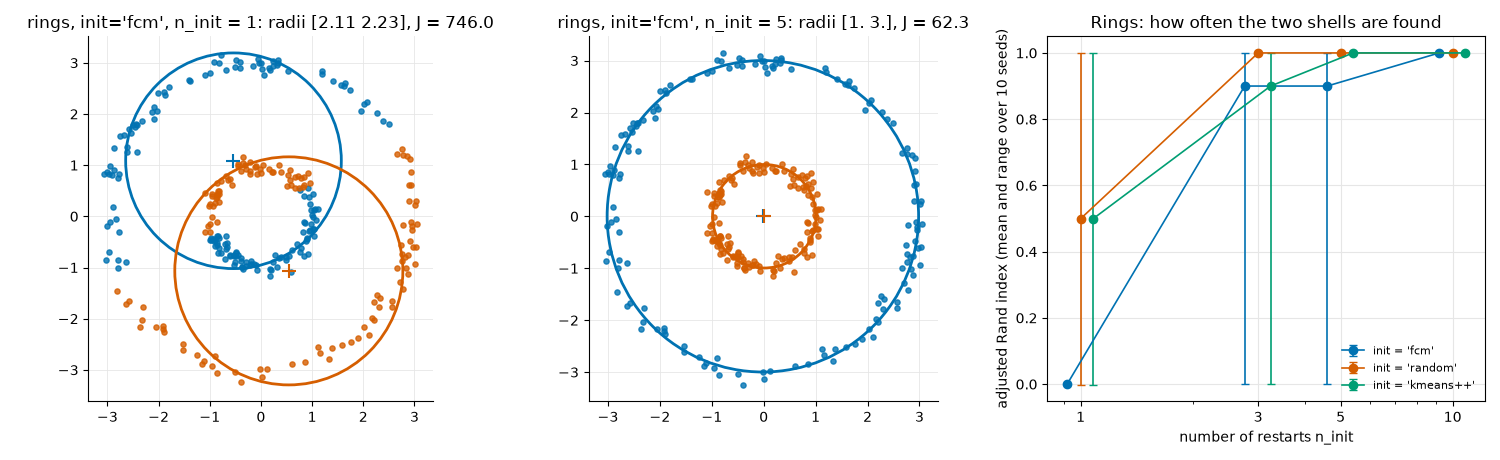
rings, init = 'fcm': mean ARI over 10 seeds for n_init = (1, 3, 5, 10): [0.  0.9 0.9 1. ]
rings, init = 'random': mean ARI over 10 seeds for n_init = (1, 3, 5, 10): [0.5 1.  1.  1. ]
rings, init = 'kmeans++': mean ARI over 10 seeds for n_init = (1, 3, 5, 10): [0.5 0.9 1.  1. ]
intersecting circles, n_init = 1: ARI with init='fcm' 0.97, init='random' 0.08
Parameter study II: FCSS versus FCS, and the exponent \(m\)#
Near a shell the algebraic distance is about \(2r_i\) times the radial one, so FCSS weights the same deviation more on a large shell than on a small one, and its memberships favor small shells. On well-separated shells both algorithms give the same answer; with three concentric rings of radii 1, 1.6 and 3 the bias shows: FCS separates the two inner rings more reliably, at the price of the Newton steps. The exponent \(m\) plays its usual role and hardly changes the difference between FCSS and FCS.
X3, y3 = make_rings(n_samples_per_ring=120, radii=(1.0, 1.6, 3.0), noise=0.06, random_state=0)
fig, axes = plt.subplots(1, 2, figsize=(11, 4.8))
for ax, algorithm in zip(axes, ("fcss", "fcs"), strict=True):
    model = FuzzyCShells(n_clusters=3, algorithm=algorithm, n_init=10, random_state=0).fit(X3)
    plot_shells(X3, model, ax=ax)
    ax.set_title(f"{algorithm.upper()} on three rings: radii {np.sort(model.radii_).round(2)}, "
                 f"ARI = {adjusted_rand_score(y3, model.labels_):.2f}")
plt.tight_layout()
print("three concentric rings, ARI (mean over 5 seeds, n_init = 10):")
for algorithm in ("fcss", "fcs"):
    aris = [adjusted_rand_score(y3, FuzzyCShells(n_clusters=3, algorithm=algorithm, n_init=10, random_state=s).fit(X3).labels_)
            for s in range(5)]
    print(f"  {algorithm}: {np.mean(aris):.2f} (min {np.min(aris):.2f})")
print("intersecting circles: center / radius error and memberships against m")
for m in (1.3, 2.0, 3.0):
    for algorithm in ("fcss", "fcs"):
        model = FuzzyCShells(n_clusters=3, m=m, algorithm=algorithm, random_state=0).fit(Xc)
        ce, re = match(model, true_c, true_r)
        print(f"  m = {m}, {algorithm}: center error {ce:.3f}, radius error {re:.3f}, "
              f"mean max membership {model.membership_.max(axis=1).mean():.2f}")
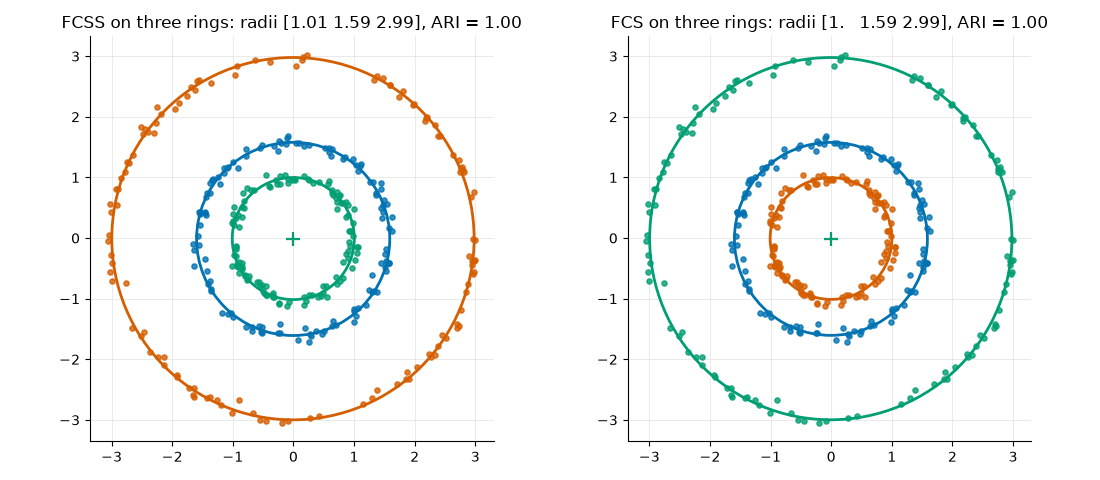
three concentric rings, ARI (mean over 5 seeds, n_init = 10):
  fcss: 0.80 (min 0.50)
  fcs: 0.90 (min 0.50)
intersecting circles: center / radius error and memberships against m
  m = 1.3, fcss: center error 0.015, radius error 0.007, mean max membership 1.00
  m = 1.3, fcs: center error 0.016, radius error 0.010, mean max membership 1.00
  m = 2.0, fcss: center error 0.015, radius error 0.007, mean max membership 0.99
  m = 2.0, fcs: center error 0.016, radius error 0.009, mean max membership 0.98
  m = 3.0, fcss: center error 0.014, radius error 0.007, mean max membership 0.95
  m = 3.0, fcs: center error 0.016, radius error 0.008, mean max membership 0.93
Take-away. Replacing the point prototype by a center and a radius lets the c-means functional describe hollow clusters; the membership formula is unchanged and depends on the radial deviation from the shell. FCSS with the algebraic distance has a closed-form update and is the default; FCS with the radial distance is unbiased with respect to the shell size and worth its Newton steps when nested shells of similar radius must be separated. Start from the hardened FCM partition for separate or intersecting shells, and use restarts for concentric ones.
Total running time of the script: (0 minutes 4.421 seconds)
