
Relational, categorical and mixed data#
Fuzzy clustering when the objects are not feature vectors or the mean is meaningless: relational fuzzy c-means as the exact dual of FCM on a matrix of squared distances and its non-Euclidean extension with the adaptive β-spread (NERF), fuzzy c-medoids on dynamic-time-warping dissimilarities of time series with the linear-complexity candidate search, fuzzy k-modes on categorical survey data, fuzzy k-prototypes on mixed records with the weight γ, Gower’s coefficient as a bridge between mixed data and the relational algorithms, and autocorrelation-based clustering of time series.
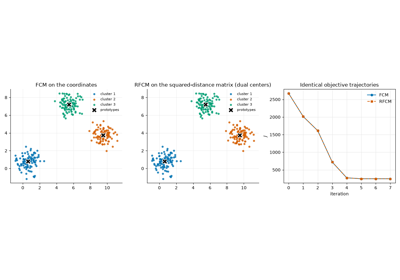
Relational fuzzy c-means and NERF for non-Euclidean data
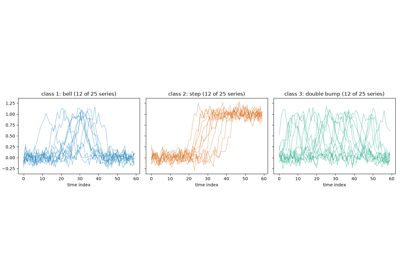
Fuzzy c-medoids on dynamic-time-warping dissimilarities of time series
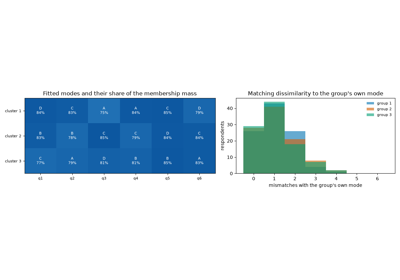
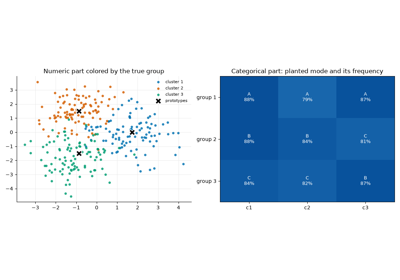
Fuzzy k-prototypes on mixed numeric and categorical data
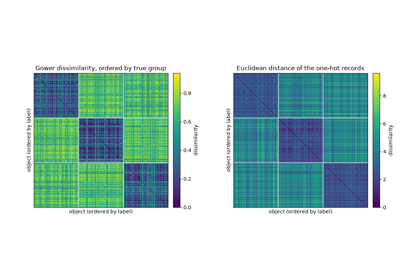
Gower’s dissimilarity versus one-hot encoding for mixed data
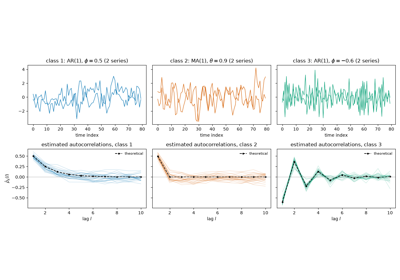
Autocorrelation-based fuzzy clustering of time series