
Clustering for model identification#
Fuzzy clusters in the product space of inputs and outputs are local models: Takagi–Sugeno fuzzy models of static functions and of SISO / MIMO dynamic systems (modified Gath–Geva clustering), switching regression with fuzzy c-regression models, fuzzy classifiers from supervised clustering, supervised fuzzy partitions for decision trees, and hinging-hyperplane regression trees.
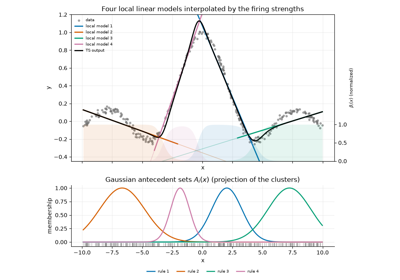
Takagi–Sugeno model of a static nonlinearity: clusters become rules
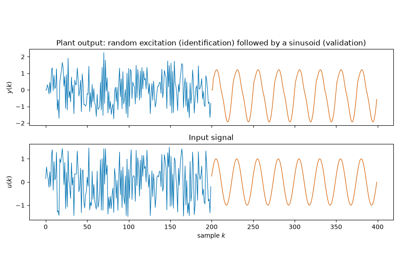
Identification of a nonlinear dynamic system with free-run validation
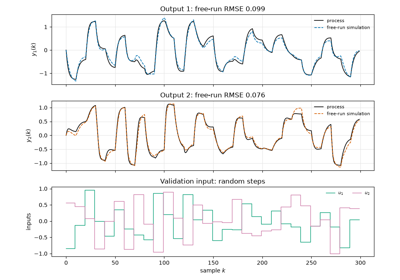
MIMO Takagi–Sugeno model with local MIMO ARX consequents
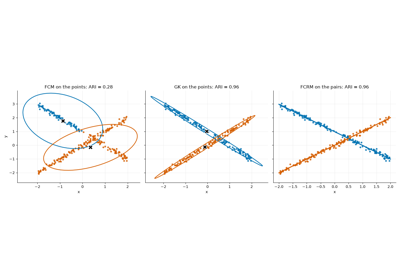
Fuzzy c-regression models: switching regression with crossing lines
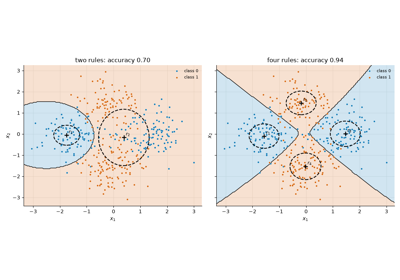
Supervised fuzzy clustering: classifier rules that carry class probabilities
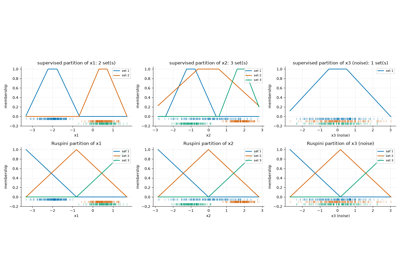
Supervised fuzzy partitions as a priori discretization for decision trees
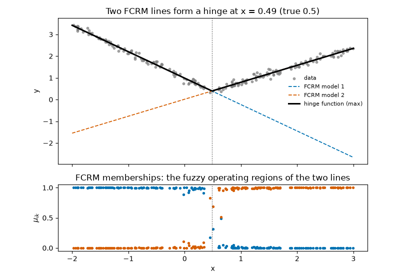
Hinging-hyperplane regression tree identified by fuzzy c-regression