Robust and shape-oriented variants of fuzzy c-means#
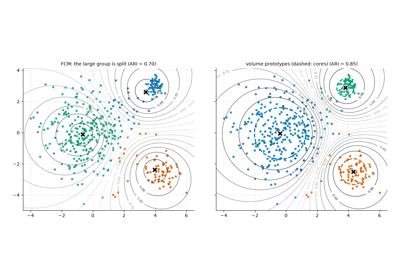
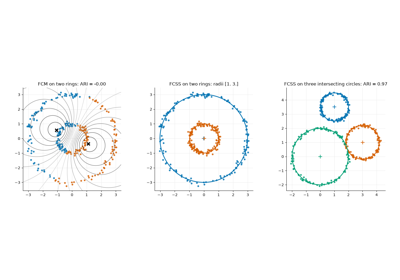
Fuzzy c-means assumes compact, roughly spherical clusters and is pulled away by outliers. These examples relax one assumption at a time: the possibilistic c-means (absolute typicalities, their scale parameters and the coincident-cluster failure), the possibilistic fuzzy c-means (memberships and typicalities with the a/b trade-off), noise clustering (a virtual noise cluster at constant distance δ), kernel fuzzy c-means (rings and moons with a kernel-width scan), fuzzy c-varieties and c-elliptotypes (lines as prototypes on crossing and collinear segments, compared with GK) and fuzzy c-shells (circles as prototypes on concentric and intersecting circles with radius recovery), volume prototypes with adaptive merging, and feature weighting (weighted FCM and SCAD) that learns which variables matter.
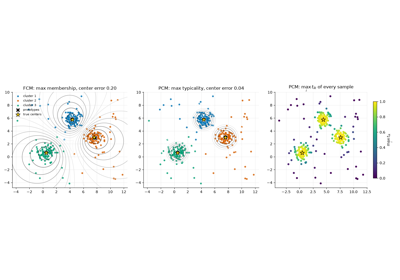
Possibilistic c-means: typicalities, scales and coincident clusters
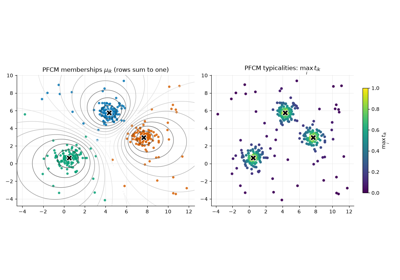
Possibilistic fuzzy c-means: memberships and typicalities together
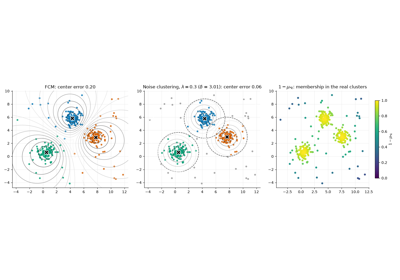
Noise clustering: a virtual cluster at constant distance δ
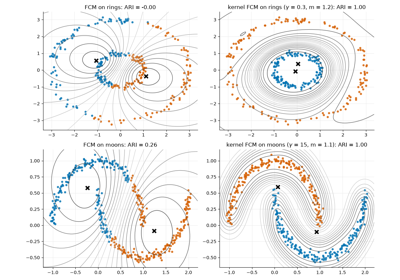
Kernel fuzzy c-means: rings and moons through the kernel trick
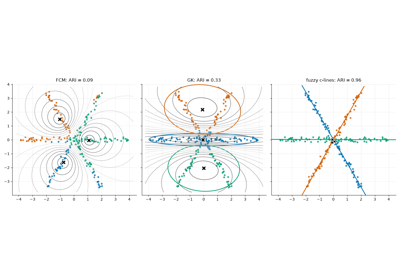
Fuzzy c-varieties: lines as prototypes, and the elliptotype compromise
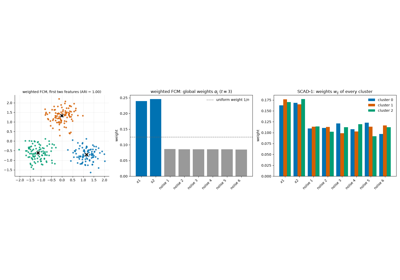
Learning which features matter: SCAD and the weighted FCM