
Note
Go to the end to download the full example code or to run this example in your browser via Binder.
On-line segmentation with recursive PCA#
Dobos and Abonyi (2012) segment process data on line: a recursive PCA model is updated at every sample with a variable forgetting factor, and the Krzanowski similarity between the running model and the model of the current segment signals a change. Because the recursive model needs some samples to follow a change, the detection comes with a delay; a retrospective search over the samples of the closing segment localizes the change exactly.
import matplotlib.pyplot as plt
import numpy as np

import mvtsa as mv
from mvtsa import segmentation as sg

X, cps, _ = mv.datasets.make_correlation_switching(
    n_segments=4, length=250, n_variables=4, random_state=5
)
Batch use#
rp = sg.RecursivePCASegmenter(
    threshold=0.7, n_components=1, forgetting=0.97, warmup=60, patience=8
)
seg = rp.segment(X)
print("detected:", seg.change_points, " true:", cps)
fig, axes = plt.subplots(3, 1, figsize=(7, 5.5), sharex=True)
mv.viz.plot_segmentation(X, seg, truth=cps, ax=axes[0])
axes[1].plot(rp.similarity_, color="#285780", lw=1)
axes[1].axhline(rp.threshold, color="#D55E00", ls="--", lw=1)
axes[1].set_ylabel("similarity")
axes[2].plot(rp.forgetting_, color="#009E73", lw=1)
axes[2].set_ylabel("forgetting")
axes[2].set_xlabel("sample")
for ax in axes[1:]:
    for c in cps:
        ax.axvline(c, color="gray", ls=":", lw=0.8)
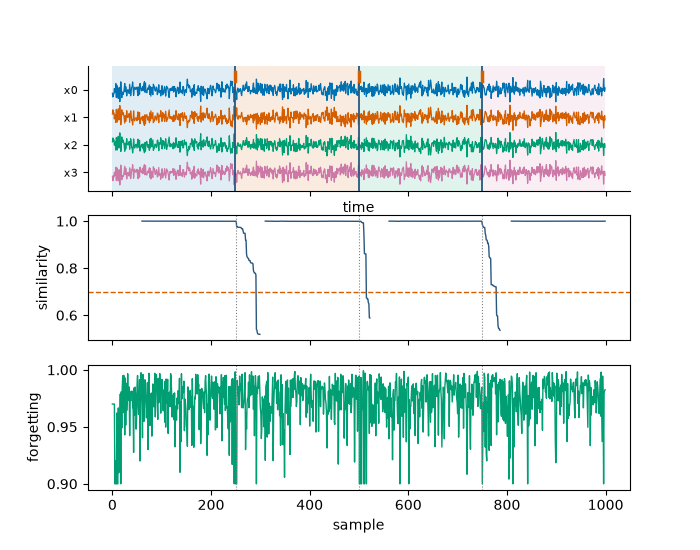
detected: [250 501 749] true: [250 500 750]
Stream use#
partial_fit() processes one sample at a time and returns True when
a change point has been declared. The scaling must be fixed in advance.
stream = sg.RecursivePCASegmenter(
    threshold=0.7,
    n_components=1,
    forgetting=0.97,
    warmup=60,
    patience=8,
    scale=(X[:200].mean(0), X[:200].std(0)),
)
for t, x in enumerate(X):
    if stream.partial_fit(x):
        print(f"sample {t}: change declared at {stream.change_points_[-1]}")
sample 299: change declared at 250
sample 522: change declared at 501
sample 786: change declared at 749
Parameter study: forgetting factor and detection delay#
Without the retrospective localization, the reported change point is the moment of detection; a smaller forgetting factor follows changes faster but makes the similarity noisier.
for lam in (0.95, 0.97, 0.99):
    s = sg.RecursivePCASegmenter(
        threshold=0.7,
        n_components=1,
        forgetting=lam,
        warmup=60,
        patience=8,
        refine=False,
    ).segment(X)
    d = [
        int(np.min(np.abs(s.change_points - c)))
        if len(s.change_points)
        else -1
        for c in cps
    ]
    print(f"forgetting {lam}: detections {s.change_points}, delays {d}")
plt.show()
forgetting 0.95: detections [277 515 764], delays [27, 15, 14]
forgetting 0.97: detections [292 515 779], delays [42, 15, 29]
forgetting 0.99: detections [302 559 806], delays [52, 59, 56]
Total running time of the script: (0 minutes 0.329 seconds)
