mvtsa.datasets.make_correlation_switching#
- mvtsa.datasets.make_correlation_switching(n_segments=4, length=200, n_variables=3, n_latent=1, noise=0.05, n_states=None, min_angle_deg=45.0, random_state=None)[source]#
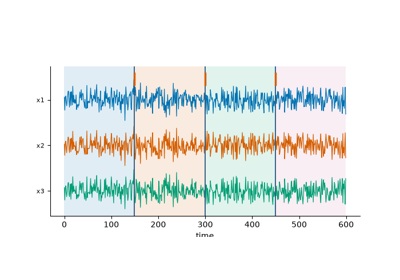
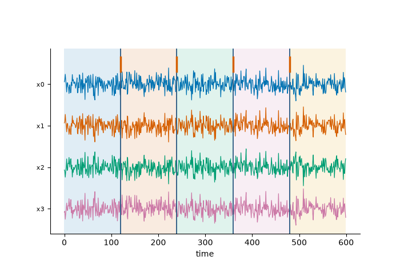
Segments with equal means and variances but different correlation structure: in every state the variables are driven by
n_latenthidden factors through a different (random orthonormal) loading matrix, whose principal subspaces are at leastmin_angle_degapart. Univariate statistics cannot see these changes; PCA-based methods can (the setting of correlation-based segmentation and warping).
Examples using mvtsa.datasets.make_correlation_switching#
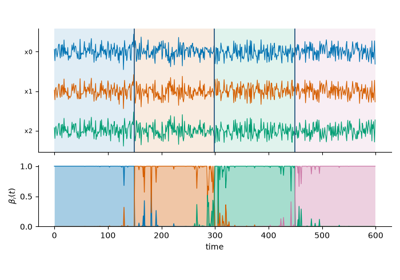
Fuzzy segmentation with the modified Gath–Geva algorithm
Fuzzy segmentation with the modified Gath--Geva algorithm