Ctrl+K

mvtsa

  • Installation
  • Example gallery
  • API reference
  • Method lineage
  • The book
    • Citing
    • Changelog
    • All textbooks
  • GitHub
  • Installation
  • Example gallery
  • API reference
  • Method lineage
  • The book
  • Citing
  • Changelog
  • All textbooks
  • GitHub

Section Navigation

  • First steps: series, segmentations, representations, PCA models
    • First steps: segment, look, evaluate
    • Representations: PAA, PLA, SAX, episodes
    • PCA models: T², Q and similarity factors
  • Cost-based segmentation: costs, search strategies, number of segments
    • Costs and search strategies
    • The merge hierarchy: segmentogram and persistence
    • How many segments?
  • Latent-variable segmentation: PCA, dynamic PCA, recursive PCA, fuzzy and Fisher segmentation
    • PCA segmentation with the T² and Q statistics
    • Dynamic PCA segmentation
    • On-line segmentation with recursive PCA
    • Fuzzy segmentation with the modified Gath–Geva algorithm
    • Informative segments for parameter estimation (MMA polymerization)
    • Operating ranges of an energy indicator
  • Probabilistic, profile-based and state-based segmentation
    • Bayesian on-line change point detection
    • Recurring operating states
    • Shape changes: ClaSP and FLUSS
    • Predictive homogeneity with any scikit-learn model
    • Consensus of segmentations
    • Segmentation of a data stream
  • Elastic similarity: DTW and its relatives
    • Dynamic time warping and global constraints
    • A family of elastic measures on Cylinder–Bell–Funnel
    • Soft-DTW: a differentiable alignment and its uncertainty
    • Diagnosing and tuning warping
  • Correlation-based and segment-level warping
    • Correlation-based dynamic time warping
    • When the information is in the correlation structure
    • Process-dynamics-aware warping: DPCA-CBDTW
    • Real data: Japanese vowels and Riemannian local distances
    • Piecewise linear warping: MPLA, SPLA and MDPLA
    • A multivariate mixed segment distance
    • Comparing qualitative trends: episode alignment
  • Clustering time series, segments and trajectories
    • Partitional clustering: k-means, k-Shape, k-medoids
    • Hierarchical clustering and distance maps
    • Clustering multivariate recordings: BasicMotions
    • Clustering segments: recurring patterns across series
    • Objects that move together: trajectory clustering
  • Evaluation, validation and benchmarking
    • Measuring segmentation quality
    • Is the segmentation stable?
    • Benchmarking segmenters with statistical tests
    • Tuning segmenter parameters
  • Visualization and interpretation
    • A one-page segmentation report
    • Six-sigma visibility graphs
    • Series as images and networks
    • Looking inside alignments and collections
  • Reproducible analyses and model operations
    • From analysis to a deployable model
    • Monitoring a deployed model for drift
    • Experiment tracking and model cards
  • Case studies
    • Grade transitions of a polymerization reactor
    • Operating regions of a pH neutralization process
    • Explaining operating regimes
  • Example gallery
  • Reproducible analyses and model operations

Reproducible analyses and model operations#

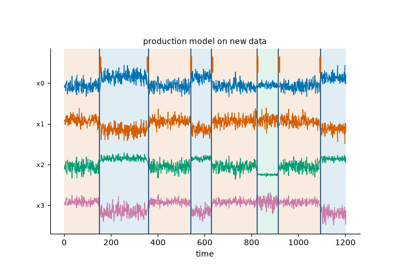
From analysis to a deployable model

From analysis to a deployable model

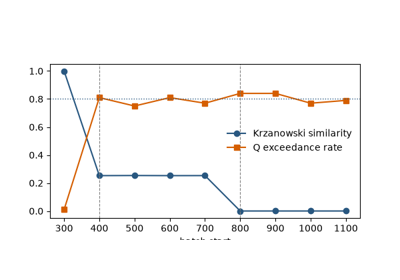
Monitoring a deployed model for drift

Monitoring a deployed model for drift

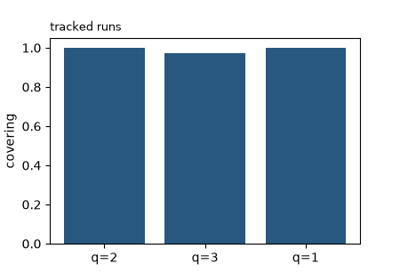
Experiment tracking and model cards

Experiment tracking and model cards

previous

Looking inside alignments and collections

next

From analysis to a deployable model

Show Source

© Copyright 2026, János Abonyi.

Created using Sphinx 9.1.1.