
Note
Go to the end to download the full example code or to run this example in your browser via Binder.
A family of elastic measures on Cylinder–Bell–Funnel#
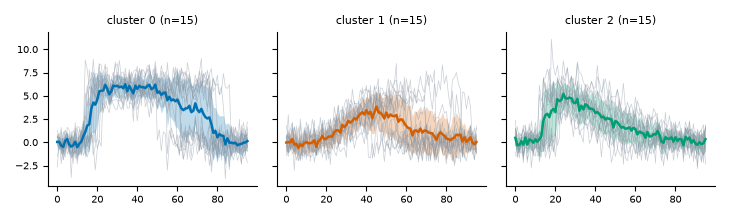
The CBF problem (Saito, 1994) is the classic test of elastic measures: the three classes differ in shape, but the onset and length of the events vary. The leave-one-out 1-nearest-neighbour accuracy compares Euclidean distance, DTW and its variants (derivative, weighted, amerced, shape-based) and the edit-type measures (LCSS, EDR, ERP, TWED, MSM).
import time

import matplotlib.pyplot as plt
import pandas as pd

from mvtsa import pairwise_distances, viz
from mvtsa.datasets import make_cbf
from mvtsa.evaluation import knn_accuracy

C, y = make_cbf(n_per_class=15, length=96, random_state=0)
viz.plot_cluster_prototypes(C, y, ncols=3)
<Figure size 730x220 with 3 Axes>
Leave-one-out 1-NN accuracy#
measures = {
    "euclidean": {},
    "dtw": {},
    "dtw (10% band)": {"metric": "dtw", "window": 0.1},
    "ddtw": {},
    "wdtw": {"g": 0.05},
    "adtw": {"penalty": 0.5},
    "shape_dtw": {"width": 9},
    "lcss": {"epsilon": 0.5, "delta": 10},
    "edr": {"epsilon": 0.25},
    "erp": {},
    "twed": {},
    "msm": {"c": 0.5},
    "sbd": {},
}
rows = []
for name, kw in measures.items():
    kw = dict(kw)
    metric = kw.pop("metric", name)
    t0 = time.perf_counter()
    D = pairwise_distances(C, metric=metric, **kw)
    rows.append(
        {
            "measure": name,
            "1-NN accuracy": knn_accuracy(D, y),
            "seconds": time.perf_counter() - t0,
        }
    )
table = pd.DataFrame(rows).sort_values("1-NN accuracy", ascending=False)
print(table.round(3).to_string(index=False))
fig, ax = plt.subplots(figsize=(6, 3.2))
ax.barh(table["measure"], table["1-NN accuracy"], color="#285780")
ax.invert_yaxis()
ax.set_xlabel("leave-one-out 1-NN accuracy")
ax.set_xlim(0.5, 1.0)
plt.show()
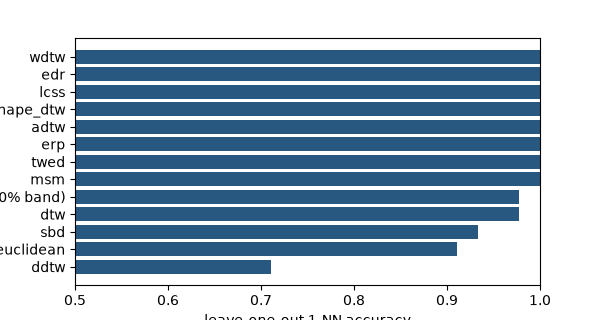
       measure  1-NN accuracy  seconds
          wdtw          1.000    0.105
           edr          1.000    0.196
          lcss          1.000    0.245
     shape_dtw          1.000    0.283
          adtw          1.000    0.068
           erp          1.000    0.253
          twed          1.000    2.849
           msm          1.000    0.258
dtw (10% band)          0.978    0.060
           dtw          0.978    0.068
           sbd          0.933    0.028
     euclidean          0.911    0.006
          ddtw          0.711    0.080
Total running time of the script: (0 minutes 4.666 seconds)
