mvtsa.segmentation.FisherSegmenter#
- class mvtsa.segmentation.FisherSegmenter(method='criterion', n_segments=3, criterion='E', window=30, segmentation='bottomup', n_eigenvectors=1, initial_size=10, Q=None, log_criterion=True, threshold=None)[source]#
Bases:
BaseSegmenterSegmentation of historical data by the information they carry on the parameters of a process model.
fittakes the sensitivitiesS(T, p)or(T, n_outputs, p)(computed from the model along the measured inputs, e.g. byfinite_difference_sensitivities()orarx_sensitivities()), not the raw measurements.- Parameters:
- method{“criterion”, “eigen”}
See the module documentation.
- n_segments
int,optional - criterion{“E”, “logD”, “A”, “Emin”}
OED criterion of the
"criterion"method.- window
int Moving window of the criterion series.
- segmentation{“bottomup”, “paa”}
How the criterion series is segmented: bottom-up with the L2 cost, or PAA (equal-length frames) as in Dobos et al. (2009).
- n_eigenvectors
int Number of leading FIM eigenvectors compared by the
"eigen"method.- initial_size
int Initial segment length of the bottom-up searches.
- Q
array,optional Output weighting (inverse measurement-error covariance).
- log_criterionbool
Segment the logarithm of a positive criterion (E, A, Emin).
- Attributes:
- criterion_
array(T,) Evaluating time series (
"criterion"method).- ranking_
pandas.DataFrame OED criteria of every segment, most informative first (by logD).
- criterion_
Examples
>>> rng = np.random.default_rng(1)
>>> u = np.r_[np.zeros(100), rng.normal(size=100), np.zeros(100)]
>>> S = np.column_stack([u, 0.1 * np.ones(300)])     # sensitivities
>>> seg = FisherSegmenter(n_segments=3, window=20).segment(S)
>>> seg.n_segments
3
Examples using mvtsa.segmentation.FisherSegmenter#
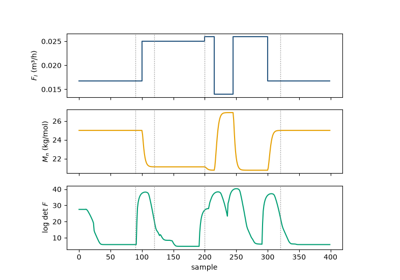
Informative segments for parameter estimation (MMA polymerization)