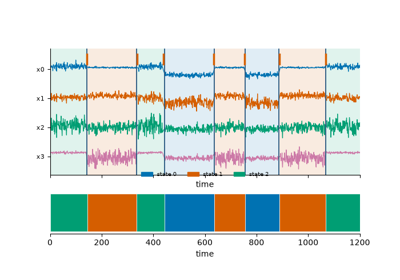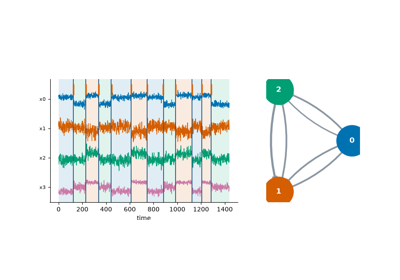
mvtsa.segmentation.GaussianHMMSegmenter#
- class mvtsa.segmentation.GaussianHMMSegmenter(n_states=3, covariance='full', sticky=0.0, max_iter=100, tol=0.0001, n_init=2, max_states=8, standardize=True, random_state=0, min_duration=1)[source]#
Bases:
BaseSegmenterState detection with a Gaussian HMM.
- Parameters:
- n_states
intor “bic” Number of hidden states, or select it from 1..``max_states`` by BIC.
- covariance{“full”, “diag”}
- sticky
float Pseudo-count added to the self-transitions in every M-step.
- max_iter, tol
int,float - n_init
int Restarts from different k-means initializations (best likelihood kept).
- max_states
int Upper bound for
n_states="bic".- standardizebool
- random_state
int,optional - min_duration
int Runs of a state shorter than this are absorbed by their neighbours after decoding (see
mvtsa.simplify.smooth_states()).
- n_states
- Attributes: