
Open book · version 1.0 · November 2026
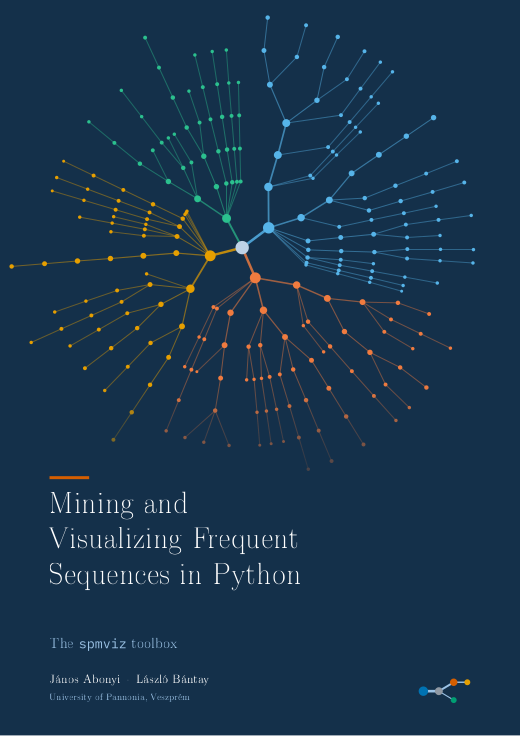
Mining and Visualizing Frequent Sequences in Python
The spmviz toolbox
Event logs record what happened and in which order: clicks, alarms, operator actions, moves,
daily activities. Sequential pattern mining condenses them into the sequences that many cases share; this book shows
how to see them. It develops the network-based visualization of frequent sequences and places it among some forty
other views — trees and sunbursts, Sankey diagrams and higher-order networks, matrices, landscapes, lattices, index
plots, dotted charts and sequence logos — each with the spmviz Python package. Every figure of a
computed result comes from an example script that runs as a Jupyter notebook.
Contents
- Preface
- 1Introduction
- 2Sequences, patterns and their mining
- 3A map of the visualizations of frequent sequences
- 4Network-based visualization of frequent sequences
- 5Trees of prefixes and patterns
- 6Flows and transitions
- 7Matrices, maps and sets
- 8Sequence views and summaries
- 9Interoperability
- 10Benchmarks and case studies
- AAPI reference
- BFrom the NbVFS scripts to spmviz
- CThe example gallery
- Bibliography
© 2026 János Abonyi, László Bántay. This book is licensed under the Creative Commons Attribution 4.0 International License (CC BY 4.0, https://creativecommons.org/licenses/by/4.0/): it may be copied, redistributed, and adapted for any purpose, provided the source is credited. The spmviz software described in the book is released under the MIT License.
Software: https://github.com/ComplexSystemsIntelligence/spmviz
Documentation: https://complexsystemsintelligence.github.io/spmviz
Installation: pip install spmviz
The research summarized in this book was supported by the National Research, Development and Innovation Office of Hungary (NKFIH) through the OTKA 143482 project.
This web edition is generated from the same LaTeX source as the PDF edition; equations, figures, and numbering follow the PDF. Every figure that shows a computed result was produced by an example script of the package.