
Note
Go to the end to download the full example code or to run this example in your browser via Binder.
Hyper-cores#
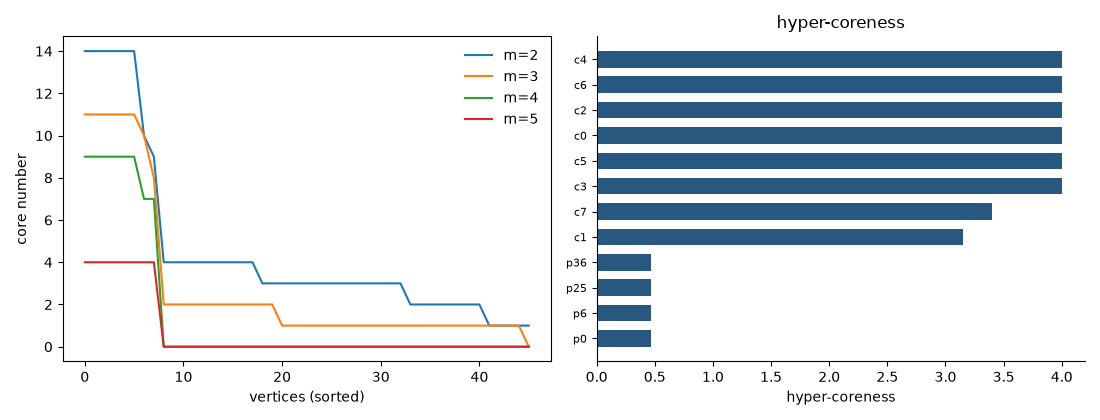
The \((k,m)\)-hyper-core keeps the vertices that belong to at least \(k\) hyperedges with at least \(m\) members inside the core (Mancastroppa et al. 2023). The core numbers for growing \(m\) and the resulting hyper-coreness reveal a densely interacting nucleus in a synthetic hypergraph with a planted core.
import matplotlib.pyplot as plt
import numpy as np
import pandas as pd

import hatvis as hv

rng = np.random.default_rng(0)
core = [f"c{i}" for i in range(8)]
periph = [f"p{i}" for i in range(40)]
edges = [list(rng.choice(core, size=rng.integers(3, 6), replace=False)) for _ in range(25)]
edges += [list(rng.choice(core + periph, size=rng.integers(2, 4), replace=False)) for _ in range(60)]
H = hv.Hypergraph(edges)
# [snippet:cores]
cores = pd.DataFrame({f"m={m}": hv.hypercore_numbers(H, m) for m in range(2, 6)})
R = hv.hypercoreness(H)
# [/snippet:cores]
print(cores.loc[core + periph[:4]])
print("top 8 by hyper-coreness:", list(R.sort_values(ascending=False).index[:8]))
    m=2  m=3  m=4  m=5
c0   14   11    9    4
c1    9    8    7    4
c2   14   11    9    4
c3   14   11    9    4
c4   14   11    9    4
c5   14   11    9    4
c6   14   11    9    4
c7   10   10    7    4
p0    4    2    0    0
p1    1    1    0    0
p2    3    0    0    0
p3    3    1    0    0
top 8 by hyper-coreness: [np.str_('c4'), np.str_('c6'), np.str_('c2'), np.str_('c0'), np.str_('c5'), np.str_('c3'), np.str_('c7'), np.str_('c1')]
fig, axes = plt.subplots(1, 2, figsize=(11, 4.2))
for m in cores.columns:
    axes[0].plot(range(len(cores)), cores[m].sort_values(ascending=False).to_numpy(), label=m)
axes[0].set_xlabel("vertices (sorted)")
axes[0].set_ylabel("core number")
axes[0].legend(frameon=False)
hv.plotting.plot_ranking(R, top=12, ax=axes[1], title="hyper-coreness")
plt.tight_layout()
Total running time of the script: (0 minutes 0.216 seconds)
