Ctrl+K

hatvis

  • Installation
  • Example gallery
  • The book
  • API reference
  • Migration guide
    • Citing
    • Changelog
    • All textbooks
  • GitHub
  • Installation
  • Example gallery
  • The book
  • API reference
  • Migration guide
  • Citing
  • Changelog
  • All textbooks
  • GitHub

Section Navigation

  • Representations and interchange
    • A first hypergraph: incidence matrix, dual and degrees
    • What the clique expansion forgets
    • Expansions, line graphs and Laplacian spectra
    • Interchange: HIF, HyperGodot files and other Python libraries
  • Matrix views
    • Seriation of the incidence matrix
    • Biclusters of the manufacturing space
    • PAOH: a dynamic hypergraph without clutter
    • UpSet view of frequent theme combinations
  • Node-link and set views
    • Six layouts of the same hypergraph
    • Seven ways to draw a hyperedge
    • Comparing groups: human and machine work
    • Linked primal and dual views
    • Circular drawing and the interactive HTML viewer
  • Similarity-based visualization
    • The HAT-VIS pipeline step by step
    • HAT-VIS case study: developing an autonomous electric car
    • Membership-aware layout: similarity with fewer intrusions
  • Walks, connectivity and centrality
    • s-walks: how strongly are hyperedges connected?
    • Critical elements of the manufacturing space
    • A family of hypergraph centralities
    • Hyper-cores
  • Clustering and partitioning
    • Community detection on a planted-partition hypergraph
    • Forming manufacturing cells from the hypergraph
    • Balanced partitioning and normalized cuts
    • Co-clustering vertices and hyperedges
  • Frequent patterns and association rules
    • Frequent itemsets as a hypergraph
    • Association rules as a directed hypergraph
    • Statistically validated hyperedges
  • Higher-order structure and null models
    • h-motifs and their significance
    • Simpliciality and nestedness: hypergraph or simplicial complex?
    • Null models: what is structure and what is chance?
  • Combinatorial problem solving
    • Covering and hitting: minimal monitoring sets
    • Acyclic hypergraphs and join trees
    • Directed hypergraphs: assembly feasibility and cost
    • QFD: which specifications should be developed?
  • Dynamics and learning
    • Diffusion and group consensus
    • Threshold contagion through groups
    • Semi-supervised learning and hyperedge prediction
  • Temporal and comparative analysis
    • Evolving narratives in a temporal hypergraph
    • Comparing two versions of a production system
  • Example gallery
  • Node-link and set views

Node-link and set views#

Layouts, hyperedge styles, groups, primal-dual views and the interactive viewer (chapter 4).

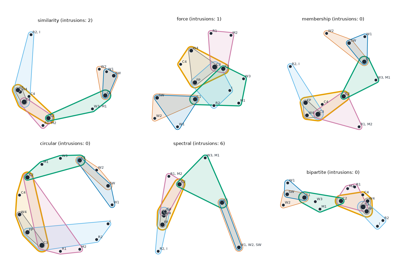
Six layouts of the same hypergraph

Six layouts of the same hypergraph

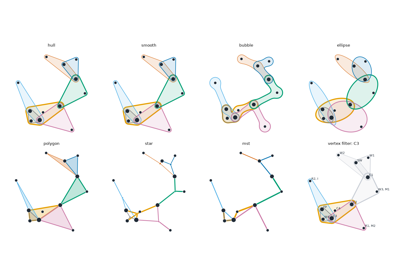
Seven ways to draw a hyperedge

Seven ways to draw a hyperedge

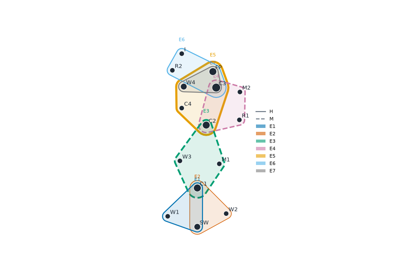
Comparing groups: human and machine work

Comparing groups: human and machine work

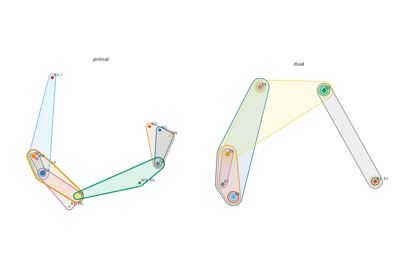
Linked primal and dual views

Linked primal and dual views

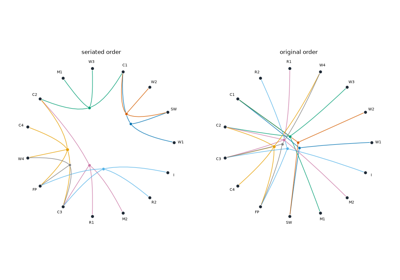
Circular drawing and the interactive HTML viewer

Circular drawing and the interactive HTML viewer

previous

UpSet view of frequent theme combinations

next

Six layouts of the same hypergraph

Show Source

© Copyright 2026, János Abonyi, Tímea Czvetkó, Attila Ficsor.

Created using Sphinx 9.1.1.