
Note
Go to the end to download the full example code or to run this example in your browser via Binder.
Five algorithms, one answer#
The package implements PrefixSpan (pattern growth), SPAM and CM-SPAM (vertical
bitmaps, the algorithm used by Bántay & Abonyi, 2024), SPADE (vertical id-lists)
and GSP (level-wise). They differ in speed, never in the result: the same
patterns with the same supports and supporting sequences. External miners
(the prefixspan package, seq2pat, gsppy, SPMF) return the same
PatternSet and can be compared in the same way.
import time

import matplotlib.pyplot as plt
import numpy as np

import spmviz as sv

db = sv.datasets.make_customer_journeys(1000, random_state=1)
Run all built-in miners#
results, times = {}, {}
for alg in ["prefixspan", "cmspam", "spam", "spade", "gsp"]:
    t0 = time.perf_counter()
    results[alg] = sv.mine(db, min_support=0.03, algorithm=alg, max_length=6)
    times[alg] = time.perf_counter() - t0
ref = results["prefixspan"]
for alg, ps in results.items():
    same = ps.patterns == ref.patterns and np.array_equal(ps.support, ref.support)
    print(f"{alg:10s} {len(ps):5d} patterns  {times[alg]:6.3f} s  identical={same}")
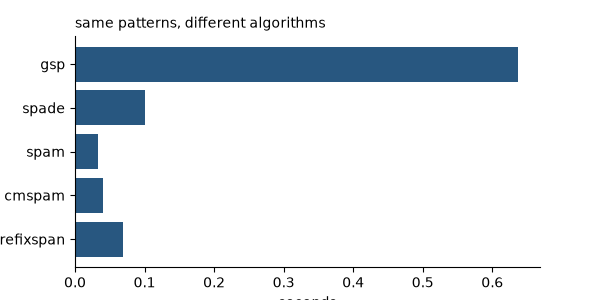
prefixspan   890 patterns   0.088 s  identical=True
cmspam       890 patterns   0.051 s  identical=True
spam         890 patterns   0.042 s  identical=True
spade        890 patterns   0.107 s  identical=True
gsp          890 patterns   0.770 s  identical=True
An external back end#
The prefixspan package (PyPI) is used when installed.
try:
    ext = sv.mine(db, 0.03, algorithm="prefixspan-py", max_length=6)
    print("prefixspan-py:", len(ext), "patterns, identical:", dict(zip(ext.patterns, ext.support)) == dict(zip(ref.patterns, ref.support)))
except ImportError:
    print("the prefixspan package is not installed")
the prefixspan package is not installed
Run times#
fig, ax = plt.subplots(figsize=(6, 3))
ax.barh(list(times), list(times.values()), color="#285780")
ax.set_xlabel("seconds")
ax.set_title("same patterns, different algorithms", loc="left", fontsize=10)
for s in ("top", "right"):
    ax.spines[s].set_visible(False)
Parameter study: top-k instead of a threshold#
When no sensible threshold is known, ask for the k most frequent patterns.
top = sv.topk(db, k=10, max_length=6)
print(top.to_frame()[["pattern", "support"]])
plt.show()
                  pattern  support
0                category      443
1                    exit      841
2                    home     1000
3                 product      617
4                  search      473
5         home → category      443
6             home → exit      841
7          home → product      617
8           home → search      473
9          product → exit      458
10  home → product → exit      458
Total running time of the script: (0 minutes 1.180 seconds)
